
SODIUM CHLORIDE 0.9% AND GLUCOSE 5% INTRAVENOUS INFUSION BP [SIN06430P]
Active ingredients: GLUCOSE MONOHYDRATE | SODIUM CHLORIDE
Last updated on 9 October 2026
Product Info
SODIUM CHLORIDE 0.9% AND GLUCOSE 5% INTRAVENOUS INFUSION BP
[SIN06430P]
Product information
Active Ingredient and Strength | GLUCOSE MONOHYDRATE - 5.5 G/100 ML |
Dosage Form | INJECTION |
Manufacturer and Country | B BRAUN MEDICAL INDUSTRIES SDN BHD - MALAYSIA |
Registration Number | SIN06430P |
Licence Holder | B. BRAUN SINGAPORE PTE LTD |
Forensic Classification | GENERAL SALE LIST |
Anatomical Therapeutic Chemical (ATC) code | B05BB02 |
Prescription-only Medicines with Exemptions for Supply without Prescription | NA |
Indication
4.1 Therapeutic indications
Isotonic dehydration
Hypotonic dehydration
Chloride losses
Vehicle solution for compatible electrolyte concentrates and medicinal products
Dosing
4.2 Posology and method of administration
Posology
Adults
The dose is adjusted according to the individual requirements of fluid, electrolyte and energy. Thus the patient’s age, weight, clinical and biological (acid-base balance) conditions and concomitant therapy should be taken into account.
Maximum daily dose:
40 ml/kg body weight (BW) per day, corresponding to 2 g glucose/kg BW per day and 6 mmol of sodium/kg BW per day.
Any additional losses (due to e.g. fever, diarrhoea, vomiting, etc.) should be substituted according to the volume and composition of the lost fluids.
Infusion rate:
The infusion rate will depend on the conditions of the individual patient (see section 4.4 – please refer to the Product Insert/Patient Information Leaflet published on HSA for the full drug information).
5 ml/kg BW per hour, corresponding to 0.25 g glucose/kg BW per hour.
Partial coverage of energy requirements, i. e. substitution of the obligatory daily glucose requirements, is only possible with the maximum dose stated above.
Vehicle solution
When Sodium Chloride 9 mg/ml and Gluose 50 mg/ml is used as vehicle solution, the dosage and the infusion rate will be principally guided by the nature and the dosage regimen of the additive.
Paediatric population
The dose is adjusted according to the individual requirements of fluid, electrolytes and energy. Thus the patient’s age, weight, clinical and biological (acid-base balance) conditions and concomitant therapy should be taken into account.
When administering this solution the total daily fluid and glucose requirements should be taken into account.
Maximum daily dose
For routine maintenance the following daily doses should not be exceeded.
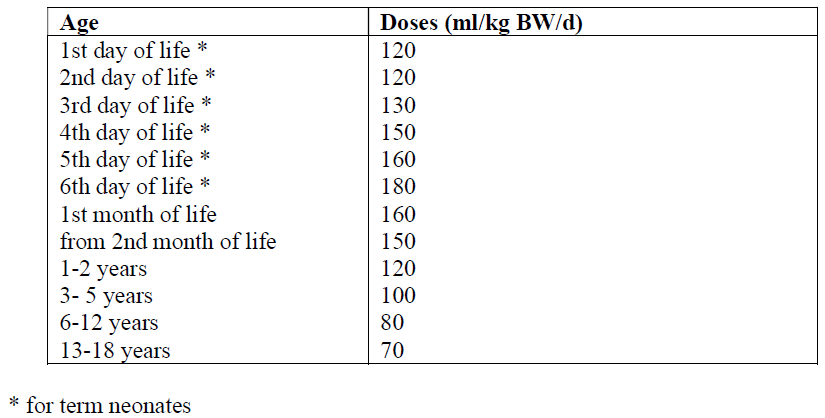
Any additional losses (due to e.g. fever, diarrhoea, vomiting) should be substituted according to the volume and composition of the lost fluids.
The dose should be calculated based on the severity of the dehydration and the clinical condition of the patient.
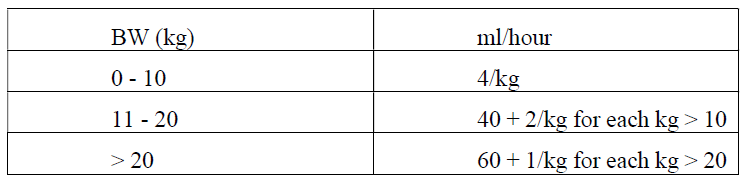
Maximum infusion rate
For routine maintenance the following infusion rates should not be exceeded.
Elderly population
Basically the same dosage as for adults applies, but caution should be exercised in patients suffering from further diseases like cardiac insufficiency or renal insufficiency that are associated with advanced age.
Other special patient groups
If the oxidative metabolism of glucose is impaired (e.g. in the early post-operative or post-traumatic period or in the presence of hypoxia or organ failure), the dosage should be adjusted to keep the blood glucose level close to normal values. Close monitoring of blood glucose levels is recommended in order to prevent hyperglycaemia. See also section 4.4 – please refer to the Product Insert/Patient Information Leaflet published on HSA for the full drug information.
Method of administration
Intravenous use
Hypertonic solutions should be administered in a large peripheral or central vein to diminish the risk of causing irritation.
Contraindications
4.3 Contraindications
Sodium Chloride 9 mg/ml and Glucose 50 mg/ml Solution for Infusion must not be used in cases of
hyperhydration
hypertonic dehydration
lactic acidosis
persistent hyperglycaemia not responding to insulin doses of up to 6 units/hour
pulmonary or brain oedema
severe hypernatraemia
severe hyperchloraemia
acute congestive heart failure