
ADCETRIS® POWDER FOR CONCENTRATE FOR SOLUTION FOR INFUSION 50MG/VIAL [SIN14477P]
Active ingredients: BRENTUXIMAB VEDOTIN
Last updated on 9 October 2026
Product Info
ADCETRIS® POWDER FOR CONCENTRATE FOR SOLUTION FOR INFUSION 50MG/VIAL
[SIN14477P]
Product information
Active Ingredient and Strength | BRENTUXIMAB VEDOTIN - 50 MG/VIAL |
Dosage Form | INJECTION, POWDER, FOR SOLUTION |
Manufacturer and Country | BSP PHARMACEUTICALS S.P.A - ITALY |
Registration Number | SIN14477P |
Licence Holder | TAKEDA PHARMACEUTICALS (ASIA PACIFIC) PTE. LTD. |
Forensic Classification | PRESCRIPTION ONLY MEDICINES |
Anatomical Therapeutic Chemical (ATC) code | L01XC12 |
Prescription-only Medicines with Exemptions for Supply without Prescription | NA |
Indication
4.1 Therapeutic indications
4.1.1 Previously untreated Stage III or IV classical Hodgkin lymphoma (cHL), in combination with chemotherapy.
ADCETRIS is indicated for the frontline treatment of adult patients with previously untreated CD30+ advanced cHL in combination with doxorubicin, vinblastine and dacarbazine (AVD)(see section 5.1 – please refer to the Product Insert/Patient Information Leaflet published on HSA for the full drug information).
4.1.2 Previously untreated Stage IIb with risk factor, Stage III or Stage IV classical Hodgkin Lymphoma (cHL), in combination with chemotherapy.
ADCETRIS is indicated for adult patients with previously untreated CD30+ Stage IIB with risk factors, Stage III or Stage IV cHL in combination with etoposide, cyclophosphamide, doxorubicin, dacarbazine, dexamethasone (BrECADD) (see sections 4.2 and 5.1 – please refer to the Product Insert/Patient Information Leaflet published on HSA for the full drug information).
4.1.3 Hodgkin lymphoma (HL) consolidation.
ADCETRIS is indicated for the treatment of adult patients with CD30+ HL at increased risk of relapse or progression following autologous stem cell transplant (ASCT) (see section 5.1 – please refer to the Product Insert/Patient Information Leaflet published on HSA for the full drug information).
4.1.4 Relapsed or refractory Hodgkin lymphoma (HL).
ADCETRIS is indicated for the treatment of adult patients with relapsed or refractory CD30+ Hodgkin lymphoma (HL):
following autologous stem cell transplant (ASCT) or
following at least two prior therapies when ASCT or multi-agent chemotherapy is not a treatment option.
4.1.5 Frontline systemic anaplastic large cell lymphoma (sALCL) or other CD30-expressing peripheral T-cell lymphomas (PTCL), in combination with chemotherapy
ADCETRIS is indicated for the treatment of patients with CD30-expressing previously untreated peripheral T-cell lymphoma (PTCL) in combination with chemotherapy.
4.1.6 Relapsed or refractory systemic anaplastic large cell lymphoma (sALCL).
ADCETRIS is indicated for the treatment of adult patients with relapsed or refractory systemic anaplastic large cell lymphoma (sALCL).
4.1.7 CD30+ cutaneous T-cell lymphoma (CTCL)
ADCETRIS is indicated for the treatment of adult patients with CD30+ cutaneous T-cell lymphoma (CTCL) after at least 1 prior systemic therapy (see section 5.1 – please refer to the Product Insert/Patient Information Leaflet published on HSA for the full drug information).
Dosing
4.2 Posology and method of administration
ADCETRIS should be administered under the supervision of a physician experienced in the use of anti-cancer agents.
Posology
Previously Untreated HL
ADCETRIS + AVD
The recommended dose in combination with chemotherapy (doxorubicin [A], vinblastine [V] and dacarbazine [D] [AVD]) is 1.2 mg/kg administered as an intravenous infusion over 30 minutes on days 1 and 15 of each 28-day cycle for 6 cycles (see section 5.1 – please refer to the Product Insert/Patient Information Leaflet published on HSA for the full drug information).
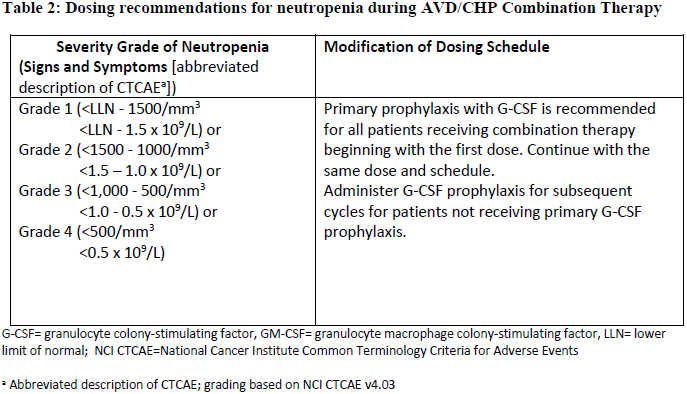
Primary prophylaxis with growth factor support (G-CSF) is recommended for all patients beginning with the first dose (see section 4.4 – please refer to the Product Insert/Patient Information Leaflet published on HSA for the full drug information).
Refer to the product insert of chemotherapy agents given in combination with ADCETRIS for frontline treatment of patients with HL.
BrECADD
The recommended dose in combination with chemotherapy (etoposide (E), cyclophosphamide (C), doxorubicin (A), dacarbazine (D), dexamethasone (D) [BrECADD]) is 1.8 mg/kg administered as an intravenous infusion over 30 minutes every 3 weeks for up to 6 cycles (see section 5.1 – please refer to the Product Insert/Patient Information Leaflet published on HSA for the full drug information).
Primary prophylaxis with growth factor support (G-CSF) must be given beginning on day 5 of each cycle for all adult patients with previously untreated HL receiving combination therapy (see section 4.4 – please refer to the Product Insert/Patient Information Leaflet published on HSA for the full drug information). Pretreatment with dexamethasone for 4 days before the first cycle of chemotherapy is recommended for patients > 40 years of age or at physician’s discretion.
An antibiotic prophylaxis must be given 3 x/week during the whole duration of chemotherapy.
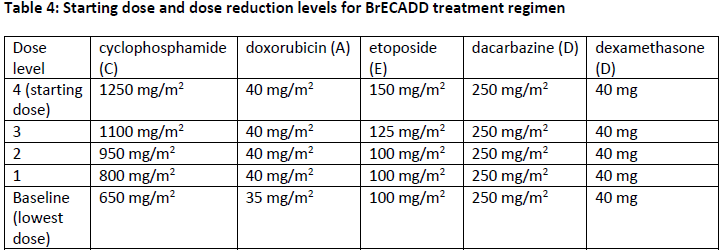
Refer to Table 4 for dosing recommendations for chemotherapy agents given in combination with ADCETRIS for patients with previously untreated HL.
HL at increased risk of relapse or progression following ASCT
The recommended dose is 1.8 mg/kg administered as an intravenous infusion over 30 minutes every 3 weeks.
ADCETRIS treatment should start following recovery from ASCT based on clinical judgment. These patients should receive up to 16 cycles (see section 5.1 – please refer to the Product Insert/Patient Information Leaflet published on HSA for the full drug information).
Relapsed or refractory HL
The recommended dose is 1.8 mg/kg administered as an intravenous infusion over 30 minutes every 3 weeks.
The recommended starting dose for the retreatment of patients with relapsed or refractory HL who have previously responded to treatment with ADCETRIS is 1.8 mg/kg administered as an intravenous infusion over 30 minutes every 3 weeks. Alternatively, treatment may be started at the last tolerated dose (see section 5.1 – please refer to the Product Insert/Patient Information Leaflet published on HSA for the full drug information).
Treatment should be continued until disease progression or unacceptable toxicity (see section 4.4 – please refer to the Product Insert/Patient Information Leaflet published on HSA for the full drug information).
Patients who achieve stable disease or better should receive a minimum of 8 cycles and up to a maximum of 16 cycles (approximately 1 year) (see section 5.1 – please refer to the Product Insert/Patient Information Leaflet published on HSA for the full drug information).
Frontline PTCL
The recommended dose in combination with chemotherapy (cyclophosphamide [C], doxorubicin [H], and prednisone [P]; [CHP]) is 1.8 mg/kg administered as an intravenous infusion over 30 minutes every 3 weeks for 6 to 8 cycles (See section 5.1 – please refer to the Product Insert/Patient Information Leaflet published on HSA for the full drug information).
Primary prophylaxis with growth factor support (G-CSF) is recommended for all patients beginning with the first dose (See section 4.4 – please refer to the Product Insert/Patient Information Leaflet published on HSA for the full drug information).
Refer to the product information of chemotherapy agents given in combination with ADCETRIS for treatment of patients with previously untreated PTCL.
Relapsed or refractory sALCL
The recommended dose is 1.8 mg/kg administered as an intravenous infusion over 30 minutes every 3 weeks.
The recommended starting dose for the retreatment of patients who have previously responded to treatment with ADCETRIS is 1.8 mg/kg administered as an intravenous infusion over 30 minutes every 3 weeks. Alternatively, treatment may be started at the last tolerated dose (see section 5.1 – please refer to the Product Insert/Patient Information Leaflet published on HSA for the full drug information).
Treatment should be continued until disease progression or unacceptable toxicity (see section 4.4 – please refer to the Product Insert/Patient Information Leaflet published on HSA for the full drug information).
Patients who achieve stable disease or better should receive a minimum of 8 cycles and up to a maximum of 16 cycles (approximately 1 year) (see section 5.1 – please refer to the Product Insert/Patient Information Leaflet published on HSA for the full drug information).
CTCL
The recommended dose is 1.8 mg/kg administered as an intravenous infusion over 30 minutes every 3 weeks.
Patients with CTCL should receive up to 16 cycles.
General
Do not administer as an IV push or bolus.
If the patient’s weight is more than 100 kg, the dose calculation should use 100 kg (see section 6.6 – please refer to the Product Insert/Patient Information Leaflet published on HSA for the full drug information).
Complete blood counts should be monitored prior to administration of each dose of this treatment (see section 4.4 – please refer to the Product Insert/Patient Information Leaflet published on HSA for the full drug information).
Patients should be monitored during and after infusion (see section 4.4 – please refer to the Product Insert/Patient Information Leaflet published on HSA for the full drug information).
Dose adjustments
Neutropenia
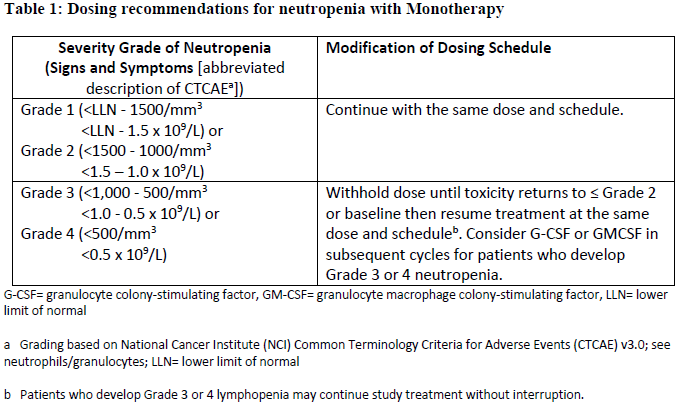
If neutropenia develops during treatment it should be managed by dose delays or dose adjustment in subsequent cycles. See Table 1, Table 2, Table 3 and Table 4 below for appropriate dosing recommendations for monotherapy and combination therapy, respectively. (see also section 4.4 – please refer to the Product Insert/Patient Information Leaflet published on HSA for the full drug information).
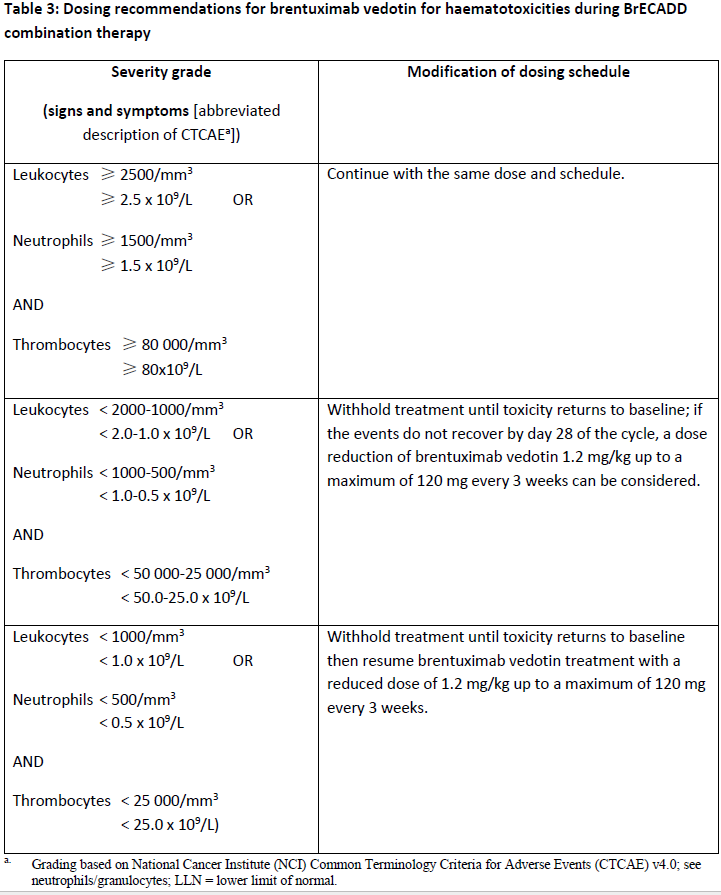
In patients receiving the BrECADD regimen, if one or more events occur in a given cycle, dose is reduced to the level below and continue for next cycles.
If events occur in two successive cycles, the dose is reduced to baseline level (see Table 4). Events include leukopenia for more than 4 days, thrombocytopenia on one or more days, infection CTCAE Grade 4, other CTCAE Grade 4 toxicities, and treatment delay of more than 2 weeks due to inadequate recovery of blood values.
Peripheral Neuropathy
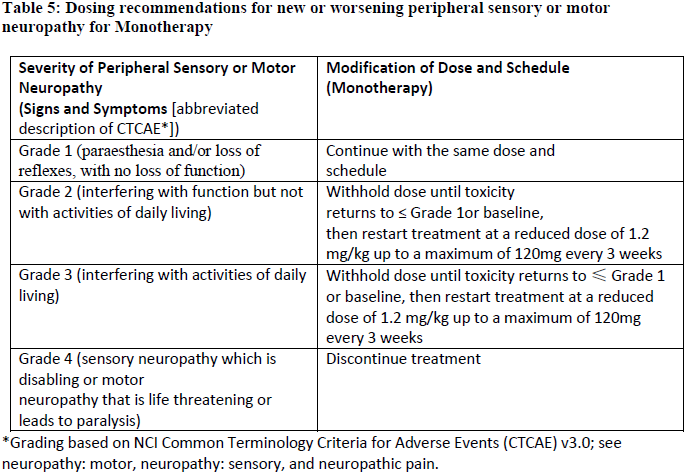
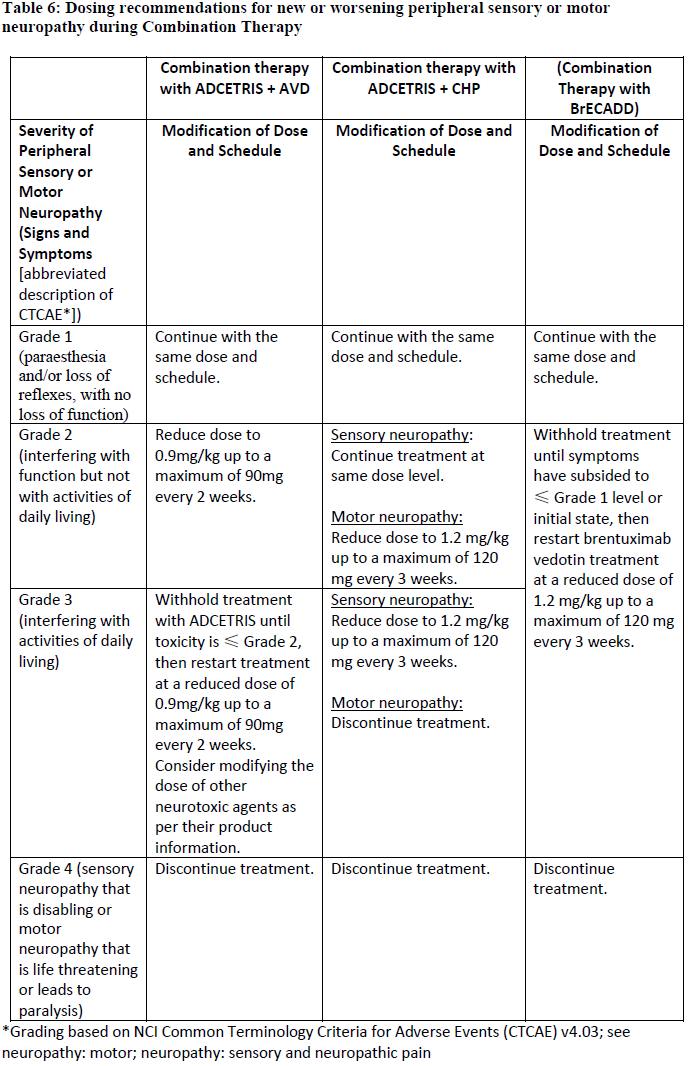
If peripheral sensory or motor neuropathy emerges or worsens during treatment see Table 5 and Table 6 below for appropriate dosing recommendations for monotherapy and combination therapy, respectively. (see section 4.4 – please refer to the Product Insert/Patient Information Leaflet published on HSA for the full drug information).
Special patient populations
Renal and hepatic impairment
– Combination therapy
Patients with renal impairment should be closely monitored for adverse events. There is no clinical trial experience using ADCETRIS in combination with chemotherapy in patients with renal impairment, where serum creatinine is ≥ 2.0 mg/dL and/or creatinine clearance or calculated creatinine clearance is ≤ 40 mL/minute. Use of ADCETRIS in combination with chemotherapy should be avoided in patients with severe renal impairment.
Patients with hepatic impairment should be closely monitored for adverse events. The recommended starting dose in patients with mild hepatic impairment receiving ADCETRIS in combination with AVD is 0.9 mg/kg (up to a maximum of 90 mg) administered as an intravenous infusion over 30 minutes every 2 weeks. The recommended starting dose in patients with mild hepatic impairment receiving ADCETRIS in combination with CHP is 1.2 mg/kg administered as an intravenous infusion over 30 minutes every 3 weeks. There is no clinical trial experience using ADCETRIS in combination with chemotherapy in patients with hepatic impairment, where total bilirubin is > 1.5 times the upper limit of normal (ULN) (unless due to Gilbert syndrome), or aspartate aminotransferase (AST) or alanine aminotransferase (ALT) are > 3 times the ULN, or > 5 times the ULN if their elevation may be reasonably ascribed to the presence of HL in the liver. Use of ADCETRIS in combination with chemotherapy should be avoided in patients with moderate and severe hepatic impairment.
– Monotherapy
The recommended starting dose in patients with severe renal impairment is 1.2 mg/kg administered as an intravenous infusion over 30 minutes every 3 weeks. Patients with renal impairment should be closely monitored for adverse events (see section 5.2 – please refer to the Product Insert/Patient Information Leaflet published on HSA for the full drug information).
The recommended starting dose in patients with hepatic impairment is 1.2 mg/kg administered as an intravenous infusion over 30 minutes every 3 weeks. Patients with hepatic impairment should be closely monitored for adverse events (see section 5.2 – please refer to the Product Insert/Patient Information Leaflet published on HSA for the full drug information).
Elderly patients
The dosing recommendations for patients aged 65 and older are the same as for adults. Currently available data are described in sections 4.8, 5.1 and 5.2 – please refer to the Product Insert/Patient Information Leaflet published on HSA for the full drug information.
The safety and efficacy of ADCETRIS as part of the BrECADD regimen in patients aged 60 years and older has not been established.
Paediatric population
The safety and efficacy of children less than 18 years have not yet been established. Currently available data are described in Pharmacokinetics (see section number 5.2 – please refer to the Product Insert/Patient Information Leaflet published on HSA for the full drug information).
In nonclinical studies, thymus depletion has been observed (see section 5.3 – please refer to the Product Insert/Patient Information Leaflet published on HSA for the full drug information).
Method of administration
The recommended dose of ADCETRIS is infused over 30 minutes.
For instructions on reconstitution and dilution of the medicinal product before administration, see section 6.6 – please refer to the Product Insert/Patient Information Leaflet published on HSA for the full drug information.
ADCETRIS must not be administered as an intravenous push or bolus. ADCETRIS should be administered through a dedicated intravenous line and it must not be mixed with other medicinal products (see section 6.2 – please refer to the Product Insert/Patient Information Leaflet published on HSA for the full drug information).
Contraindications
4.3 Contraindications
Hypersensitivity to the active substance or to any of the excipients listed in section 6.1 – please refer to the Product Insert/Patient Information Leaflet published on HSA for the full drug information.
Combined use of bleomycin and ADCETRIS causes pulmonary toxicity.