
PRALUENT SOLUTION FOR INJECTION IN A PRE-FILLED PEN 75MG/ML [SIN15228P]
Active ingredients: ALIROCUMAB
Last updated on 9 October 2026
Product Info
PRALUENT SOLUTION FOR INJECTION IN A PRE-FILLED PEN 75MG/ML
[SIN15228P]
Product information
Active Ingredient and Strength | ALIROCUMAB - 75 MG/ML |
Dosage Form | INJECTION, SOLUTION |
Manufacturer and Country | SANOFI WINTHROP INDUSTRIE (PRE-FILLED SYRINGE) - FRANCE |
Registration Number | SIN15228P |
Licence Holder | SANOFI-AVENTIS SINGAPORE PTE. LTD. |
Forensic Classification | PRESCRIPTION ONLY MEDICINES |
Anatomical Therapeutic Chemical (ATC) code | PENDING |
Prescription-only Medicines with Exemptions for Supply without Prescription | NA |
Indication
4.1 Therapeutic indications
Prevention of Cardiovascular Events
Praluent in combination with a statin or statin with other lipid lowering therapies in patients unable to reach LDL-C goals with the maximum tolerated dose of a statin is indicated:
to reduce the risk of non-fatal myocardial infarction, ischemic stroke, and unstable angina requiring hospitalization in adults with established cardiovascular disease.
Primary hypercholesterolaemia and mixed dyslipidaemia
Praluent is indicated in adults with primary hypercholesterolaemia (heterozygous familial and non-familial) or mixed dyslipidaemia, and in paediatric patients 8 years of age and older with heterozygous familial hypercholesterolaemia (HeFH) as an adjunct to diet:
in combination with a statin or statin with other lipid lowering therapies in patients unable to reach LDL-C goals with the maximum tolerated dose of a statin or,
alone or in combination with other lipid-lowering therapies in patients who are statin-intolerant, or for whom a statin is contraindicated.
Dosing
4.2 Posology and method of administration
Posology
Adults
Prior to initiating Praluent secondary causes of hyperlipidaemia or mixed dyslipidaemia (e.g., nephrotic syndrome, hypothyroidism) should be excluded.
The usual starting dose for Praluent is 75 mg administered subcutaneously once every 2 weeks, since the majority of patients achieve sufficient LDL-C reduction with this dosage. An alternative starting dosage for patients who prefer less frequent dosing is 300 mg once every 4 weeks (monthly). Patients requiring larger LDL-C reduction (>60%) may be started on 150 mg once every 2 weeks.
For patients receiving Praluent 75 mg every 2 weeks, measure LDL-C levels within 4 to 8 weeks of initiating Praluent. If the LDL-C response is inadequate, the dosage may be adjusted to the maximum dosage of 150 mg administered every 2 weeks. Reassess LDL-C within 4 to 8 weeks.
For patients receiving Praluent 300 mg every 4 weeks, measure LDL-C just prior to the next scheduled dose, since in some patients LDL-C can vary considerably between doses with this regimen. If LDL-C reduction is inadequate, the dosage may be adjusted to 150 mg every 2 weeks, starting the new dose on the next scheduled dosing date. Reassess LDL-C within 4 to 8 weeks.
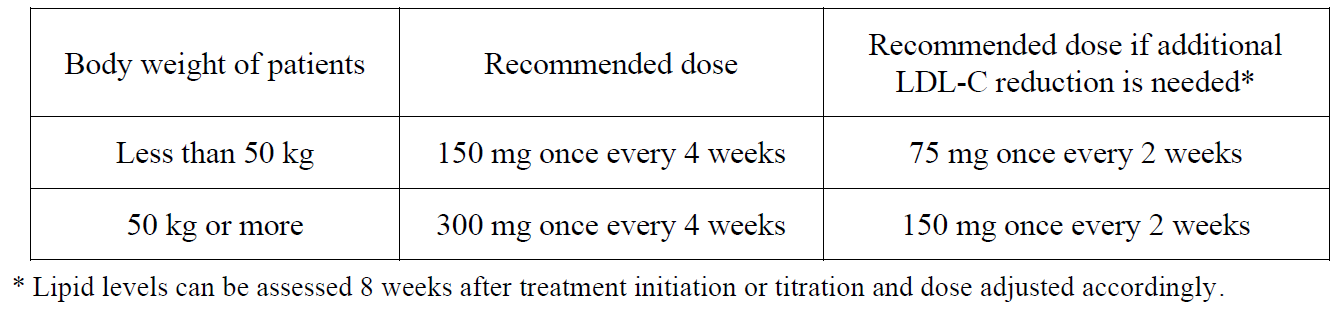
HeFH in paediatric patients 8 years of age and older
Missed dose
If an every-2-week dose is missed, instruct the patient to administer the injection within 7 days from the missed dose and then resume the patient’s original schedule. If the missed dose is not administered within 7 days, instruct the patient to wait until the next dose on the original schedule.
If an every-4-week dose is missed, instruct the patient to administer the injection within 7 days from the missed dose and then resume the patient’s original schedule. If the missed dose is not administered within 7 days, instruct the patient to administer the dose, starting a new schedule based on this date.
Special populations
Paediatric population
The safety and efficacy of Praluent in children less than 8 years of age have not been established. No data are available.
Elderly
No dose adjustment is needed for elderly patients.
Hepatic impairment
No dose adjustment is needed for patients with mild or moderate hepatic impairment. No data are available in patients with severe hepatic impairment (see section 5.2 – please refer to the Product Insert/Patient Information Leaflet published on HSA for the full drug information).
Renal impairment
No dose adjustment is needed for patients with mild or moderate renal impairment. Limited data are available in patients with severe renal impairment (see section 5.2 – please refer to the Product Insert/Patient Information Leaflet published on HSA for the full drug information).
Body weight
No dose adjustment is needed in patients based on weight.
Method of administration
Subcutaneous use.
Praluent is injected as a subcutaneous injection into the thigh, abdomen or upper arm.
To administer the 300 mg dose, two 150 mg injections should be given consecutively at two different injection sites.
It is recommended to rotate the injection site with each injection.
Praluent should not be injected into areas of active skin disease or injury such as sunburns, skin rashes, inflammation, or skin infections.
Praluent must not be co-administered with other injectable medicinal products at the same injection site.
Precautions to be taken before handling or administering the medicinal product
The solution should be allowed to warm to room temperature prior to use (see section 6.6 – please refer to the Product Insert/Patient Information Leaflet published on HSA for the full drug information).
Each pre-filled pen is for single use only.
Paediatric patients 8 years of age and older
In adolescents 12 years of age and older, it is recommended that Praluent be administered by or under the supervision of an adult.
In children less than 12 years of age, Praluent must be given by a caregiver.
Adults
Adult patients may either self-inject Praluent, or a caregiver may administer Praluent, after guidance has been provided by a healthcare professional on proper subcutaneous injection technique.
Contraindications
4.3 Contraindications
Hypersensitivity to the active substance or to any of the excipients listed in section 6.1 – please refer to the Product Insert/Patient Information Leaflet published on HSA for the full drug information.