
OMLYCLO® SOLUTION FOR INJECTION IN PRE-FILLED SYRINGE 75MG/0.5ML [SIN17345P]
Active ingredients: OMALIZUMAB
Last updated on 9 October 2026
Product Info
OMLYCLO® SOLUTION FOR INJECTION IN PRE-FILLED SYRINGE 75MG/0.5ML
[SIN17345P]
Product information
Active Ingredient and Strength | OMALIZUMAB - 75 MG/0.5 ML |
Dosage Form | INJECTION, SOLUTION |
Manufacturer and Country | CELLTRION PHARM, INC. - KOREA, REPUBLIC OF |
Registration Number | SIN17345P |
Licence Holder | CELLTRION HEALTHCARE SINGAPORE PRIVATE LIMITED |
Forensic Classification | PRESCRIPTION ONLY MEDICINES |
Anatomical Therapeutic Chemical (ATC) code | R03DX05 |
Prescription-only Medicines with Exemptions for Supply without Prescription | NA |
Indication
4.1 Therapeutic indications
Allergic Asthma
Omalizumab treatment should only be considered for patients with convincing IgE mediated asthma (see section 4.2).
Adults and adolescents (12 years of age and above)
Omalizumab is indicated as add-on therapy to improve asthma control in adult and adolescent (12 years of age and above) with severe persistent allergic asthma who have a positive skin test or in vitro reactivity to a perennial aeroallergen and who have reduced lung function (FEV1 <80%) as well as frequent daytime symptoms or night-time awakenings and who have had multiple documented severe asthma exacerbations despite daily high-dose inhaled corticosteroids, plus a long-acting inhaled beta2-agonist.
Children (6 to < 12 years of age)
Omlyclo is indicated as add-on therapy to improve asthma control with severe persistent allergic asthma who have a positive skin test or in vitro reactivity to a perennial aeroallergen and frequent daytime symptoms or night-time awakenings and who have had multiple documented severe asthma exacerbations despite daily high-dose inhaled corticosteroids, plus a long-acting inhaled beta2-agonist.
Chronic rhinosinusitis with nasal polyps (CRSwNP)
Omalizumab is indicated as an add-on therapy to intranasal corticosteroids for the treatment of CRSwNP in adults (18 years of age and above) with inadequate response to intranasal corticosteroids.
Chronic Spontaneous Urticaria (CSU)
Omalizumab is indicated as add-on therapy for the treatment of chronic spontaneous urticaria in adult and adolescent (12 years and above) patients with inadequate response to H1 antihistamine treatment.
Dosing
4.2 Posology and method of administration
Dosage regimen for Allergic Asthma and CRSwNP
Dosing for asthma and CRSwNP follows the same dosing principles.
Omalizumab treatment should be initiated and supervised by specialist physicians experienced in the diagnosis and treatment of severe persistent asthma.
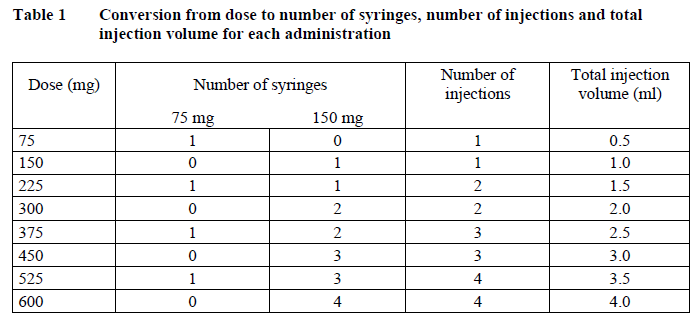
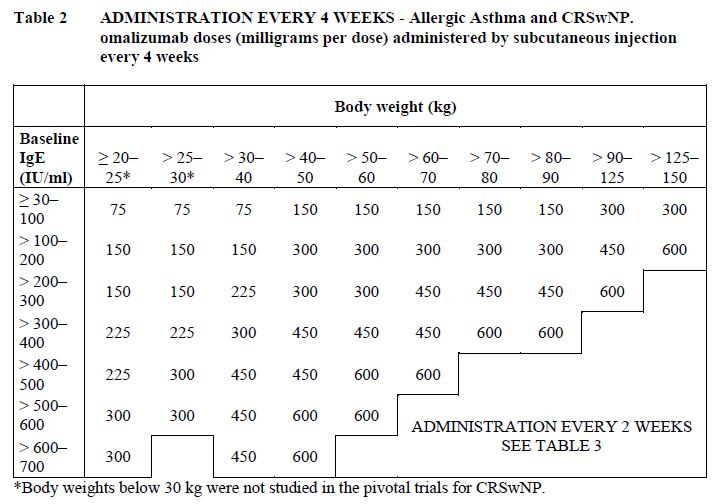
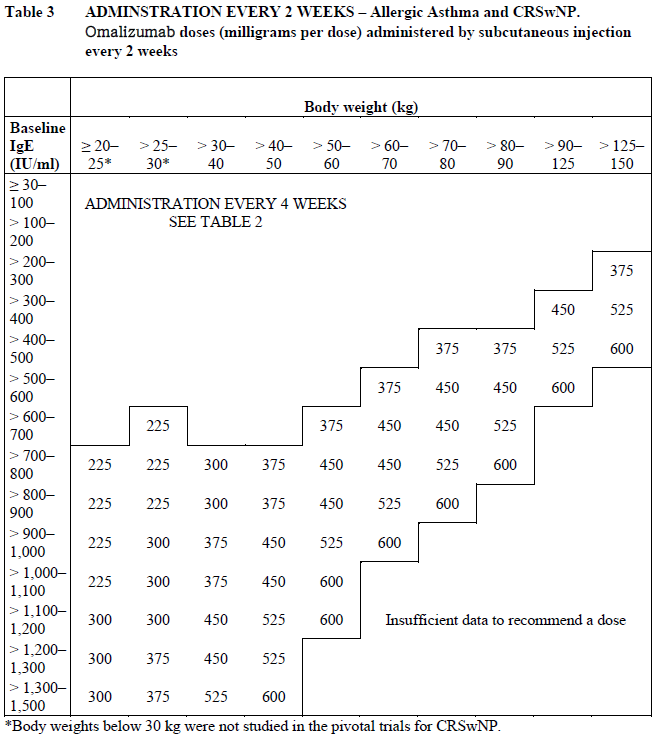
The appropriate dose and dosing frequency of omalizumab for these conditions is determined by baseline IgE (international units/ml), measured before the start of treatment, and body weight (kg). Prior to initial dosing, patients should have their IgE level determined by any commercial serum total IgE assay for their dose assignment. Based on these measurements 75–600 mg of omalizumab in 1 to 4 injections may be needed for each administration. Patients with IgE lower than 76 international units/ml were less likely to experience benefit (see section 5.1 – please refer to the Product Insert/Patient Information Leaflet published on HSA for the full drug information). Prescribing physicians should ensure that patients with IgE below 76 international units/ml have unequivocal in vitro reactivity (RAST) to a perennial allergen before starting therapy.
See Tables 1 and 2 for a conversion chart and Tables 3 and 4 for dose determination. For doses of 225, 375 or 525 mg omalizumab, 150 mg can be used in combination with omalizumab 75 mg.
Patients whose baseline IgE levels or body weight in kilograms are outside the limits of the dosing table should not be given omalizumab.
The maximum recommended dose is 600 mg omalizumab every two weeks.
Method of administration
Pre-filled syringe
For subcutaneous administration only. Omalizumab must not be administered by the intravenous or intramuscular route.
If more than one injection is needed to achieve the required dose, injections should be divided across two or more injection sites (see Table 1).
Treatment duration, monitoring and dose adjustments
Discontinuation of Omalizumab treatment generally results in a return to elevated free IgE levels and associated symptoms.
At 16 weeks after commencing Omalizumab therapy patients should be assessed by their physician for treatment effectiveness before further injections are administered. The decision to continue Omalizumab should be based on whether a marked improvement in overall asthma control is seen (see section 5.1; Physician’s overall assessment of treatment effectiveness – please refer to the Product Insert/Patient Information Leaflet published on HSA for the full drug information).
In clinical trials for CRSwNP, changes in nasal polyps score (NPS) and nasal congestion score (NCS) were observed as early as the first assessment at 4 weeks. The need for continued therapy should be periodically reassessed based upon the patient’s disease severity and level of symptom control.
Total IgE levels are elevated during treatment and remain elevated for up to one year after the discontinuation of treatment. Therefore, re-testing of IgE levels during Omalizumab treatment cannot be used as a guide for dose determination. Dose determination after treatment interruptions lasting less than one year should be based on serum IgE levels obtained at the initial dose determination. Total serum IgE levels may be re-tested for dose determination if treatment with Omalizumab has been interrupted for one year or more.
Doses should be adjusted for significant changes in body weight (see Tables 2 and 3).
Dosage regimen for Chronic Spontaneous Urticaria (CSU)
The recommended dose is 300 mg by subcutaneous injection every four weeks. Some patients may achieve control of their symptoms with a dose of 150 mg every four weeks.
Prescribers are advised to periodically reassess the need for continued therapy. Clinical trial experience of long-term treatment in this indication is described in section 5.1 – please refer to the Product Insert/Patient Information Leaflet published on HSA for the full drug information.
Special populations
Renal or hepatic impairment
There have been no studies on the effect of impaired renal or hepatic function on the pharmacokinetics of omalizumab. Because omalizumab clearance at clinical doses is dominated by the reticular endothelial system (RES) it is unlikely to be altered by renal or hepatic impairment. While no particular dose adjustment is recommended for these patients, omalizumab should be administered with caution (see section 4.4 – please refer to the Product Insert/Patient Information Leaflet published on HSA for the full drug information).
Paediatric population
In allergic asthma, safety and efficacy in patients below the age of 6 years have not been established and use of omalizumab in such patients is therefore not recommended.
In CRSwNP, safety and efficacy in patients below the age of 18 years have not been established.
In chronic spontaneous urticaria, safety and efficacy in patients below the age of 12 years have not been established.
Geriatric patients (65 years or above)
There are limited data available on the use of Omalizumab in patients 65 years and older but there is no evidence that elderly patients require a different dosage from younger adult patients.
Contraindications
4.3 Contraindications
Hypersensitivity to the active substance or to any of the excipients.