
AWIQLI® FLEXTOUCH® SOLUTION FOR INJECTION IN PRE-FILLED PEN 700 U/ML [SIN17619P]
Active ingredients: INSULIN ICODEC
Last updated on 20 November 2026
Product Info
AWIQLI® FLEXTOUCH® SOLUTION FOR INJECTION IN PRE-FILLED PEN 700 U/ML
[SIN17619P]
Product information
Active Ingredient and Strength | INSULIN ICODEC - 700 UNITS/ML |
Dosage Form | INJECTION, SOLUTION |
Manufacturer and Country | NOVO NORDISK A/S - DENMARK |
Registration Number | SIN17619P |
Licence Holder | NOVO NORDISK PHARMA (SINGAPORE) PTE LTD |
Forensic Classification | PRESCRIPTION ONLY MEDICINES |
Anatomical Therapeutic Chemical (ATC) code | A10AE07 |
Prescription-only Medicines with Exemptions for Supply without Prescription | NA |
Indication
4.1 Therapeutic indications
Treatment of type 2 diabetes mellitus in adults.
Dosing
4.2 Posology and method of administration
Posology
This medicinal product is a basal insulin for once-weekly subcutaneous administration. It is intended to be administered on the same day of the week.
The potency of insulin analogues, including insulin icodec, is expressed in units. One (1) unit of insulin icodec corresponds to 1 unit of insulin glargine (100 units/mL), 1 unit of insulin detemir, 1 unit of insulin degludec, or 1 international unit of human insulin.
Awiqli® is available in one strength, 700 units/mL. The needed dose is dialled in units. A dose of 10–700 units per injection, in steps of 10 units, can be administered.
In patients with type 2 diabetes mellitus, this medicinal product can be administered alone or in any combination with oral antidiabetic medicinal products, GLP-1 receptor agonists and bolus insulin. When insulin icodec is added to sulfonylurea therapy, discontinuation or a reduction in the dose of sulfonylurea should be considered. See sections 4.5 and 5.1 – please refer to the Product Insert/Patient Information Leaflet published on HSA for the full drug information.
Awiqli® is to be dosed in accordance with the individual patient’s needs. It is recommended to optimise glycaemic control via dose adjustment based on fasting plasma glucose.
Due to the long half-life of insulin icodec, adjustment of dose is not advised during acute illness nor if patients make short-term changes in their physical activity level or usual diet. In these situations, patients should be instructed to consult their healthcare professional for further guidance on other applicable adjustments, e.g., glucose intake or changes to other glucose lowering medication.
Initiation of Awiqli®
Patients with type 2 diabetes mellitus (insulin-naïve)
The recommended weekly starting dose is 70 units and followed by individual once-weekly dose adjustments.
Switch from once- or twice-daily basal insulin medicinal products to Awiqli® in type 2 diabetes
The first once-weekly dose of Awiqli® should be administered on the day following the last dose of once- or twice-daily basal insulin.
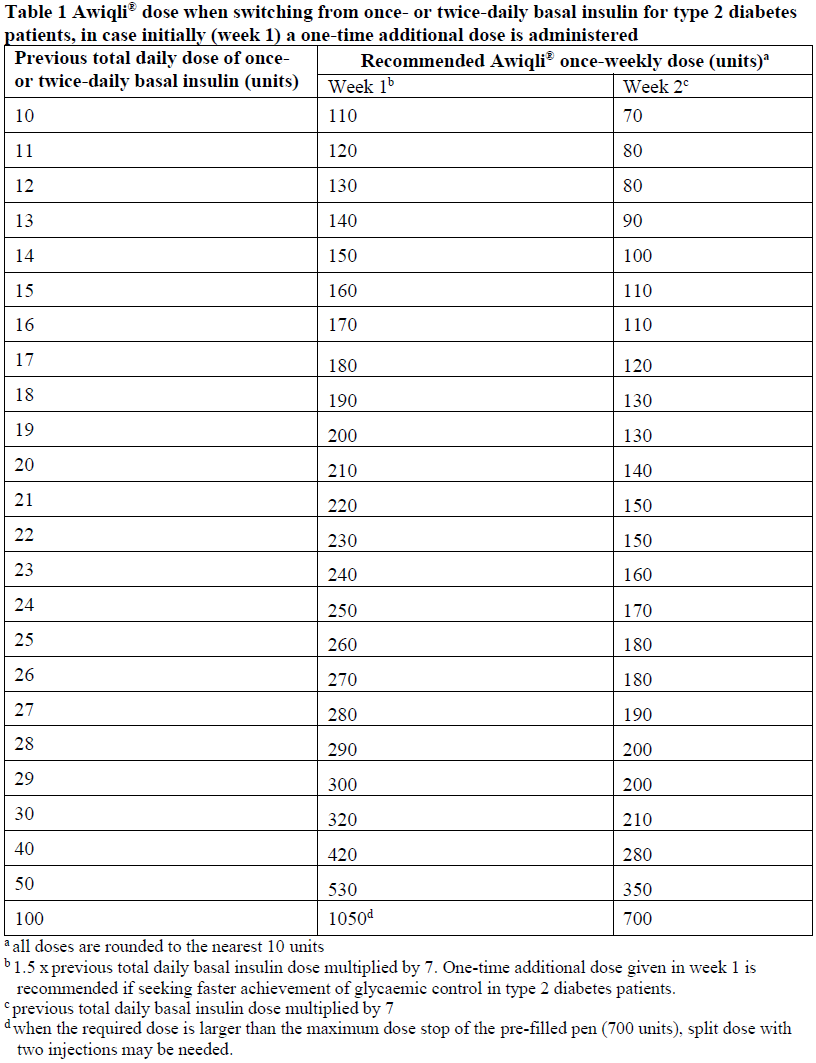
When switching patients from once- or twice-daily basal insulin, the recommended once-weekly Awiqli® dose is the total daily basal dose multiplied by 7. For the first injection only (week 1 dose), a one-time additional 50% Awiqli® dose is recommended if seeking faster achievement of glycaemic control in patients with type 2 diabetes. If the one-time additional 50% Awiqli® dose is administered, the week 1 dose should be the total daily basal insulin dose multiplied by 7 and then multiplied by 1.5, rounded to the nearest 10 units (see Table 1).
The one-time additional dose must not be added for the second injection onwards (see section 4.4 – please refer to the Product Insert/Patient Information Leaflet published on HSA for the full drug information). The second once-weekly dose of Awiqli® is the total daily basal dose multiplied by 7.
The third and subsequent once-weekly doses should be based on the patient’s metabolic needs, blood glucose monitoring results, and glycaemic control goal until the desired fasting plasma glucose is achieved. Adjustment of the dose should be made based on the self-monitored fasting glucose values on the day of titration and the two prior days.
Close glucose monitoring is recommended during the switch and in the following weeks. Doses and timing of concurrent bolus insulin products or other concomitant antidiabetic treatment may need to be adjusted.
Missed dose
If a dose is missed, it is recommended that it is administered as soon as possible.
Type 2 diabetes patients
If it is still within 3 days of the missed dose, the type 2 diabetes patient can then resume their original once weekly dosing schedule. Monitoring of fasting blood glucose should be performed.
If more than 3 days have passed, the missed dose should still be administered as soon as possible. The once weekly dosing schedule will then be changed to the day of the week where the missed dose was administered. If the original day of once-weekly administration is to be maintained, the time between subsequent doses can be successively extended to finally obtain the same administration day.
Special populations
Elderly
No dose adjustment is required for elderly patients (see section 4.8 – please refer to the Product Insert/Patient Information Leaflet published on HSA for the full drug information).
Renal impairment
No dose adjustment is required for patients with renal impairment. In patients with renal impairment, more frequent glucose monitoring is recommended (see section 5.2 – please refer to the Product Insert/Patient Information Leaflet published on HSA for the full drug information).
Hepatic impairment
No dose adjustment is required for patients with hepatic impairments. In patients with hepatic impairment, more frequent glucose monitoring is recommended (see section 5.2 – please refer to the Product Insert/Patient Information Leaflet published on HSA for the full drug information).
Paediatric population
The safety and efficacy of Awiqli® in children and adolescents below 18 years have not yet been established. No data are available.
Method of administration
Subcutaneous use only.
Awiqli® must not be administered intravenously as it may result in severe hypoglycaemia.
This medicinal product must not be administered intramuscularly as it may change the absorption.
This medicinal product must not be used in insulin infusion pumps.
Awiqli® is administered subcutaneously by injection in the thigh, the upper arm or the abdominal wall. Injection sites should always be rotated within the same region in order to reduce the risk of lipodystrophy and cutaneous amyloidosis (see section 4.4 – please refer to the Product Insert/Patient Information Leaflet published on HSA for the full drug information).
Patients should be instructed to always use a new needle. The reuse of pre-filled pen needles increases the risk of blocked needles, which may cause under- or overdosing. In the event of blocked needles, patients must follow the instructions described in the instructions for use.
Awiqli® is available in a pre-filled pen. The dose window shows the number of units of insulin icodec to be injected. No dose recalculation is required. The pre-filled pen delivers 10–700 units in steps of 10 units.
Awiqli® must not be drawn from the cartridge of the pre-filled pen into a syringe (see section 4.4 – please refer to the Product Insert/Patient Information Leaflet published on HSA for the full drug information).
For further information before administration see section 6.6 – please refer to the Product Insert/Patient Information Leaflet published on HSA for the full drug information.
Contraindications
4.3 Contraindications
Hypersensitivity to the active substance or to any of the excipients listed in section 6.1 – please refer to the Product Insert/Patient Information Leaflet published on HSA for the full drug information.