
BYLVAY® HARD CAPSULES 1200 MCG [SIN17638P]
Active ingredients: ODEVIXIBAT SESQUIHYDRATE EQV ODEVIXIBAT
Last updated on 20 November 2026
Product Info
BYLVAY® HARD CAPSULES 1200 MCG
[SIN17638P]
Product information
Active Ingredient and Strength | ODEVIXIBAT SESQUIHYDRATE EQV ODEVIXIBAT - 1.2 MG |
Dosage Form | CAPSULE |
Manufacturer and Country | PATHEON FRANCE - FRANCE |
Registration Number | SIN17638P |
Licence Holder | IPSEN PHARMA SINGAPORE PTE. LTD. |
Forensic Classification | PRESCRIPTION ONLY MEDICINES |
Anatomical Therapeutic Chemical (ATC) code | A05AX05 |
Prescription-only Medicines with Exemptions for Supply without Prescription | NA |
Indication
4.1 Therapeutic indications
Bylvay® is indicated for the treatment of progressive familial intrahepatic cholestasis (PFIC) in patients aged 6 months or older (see sections 4.4 and 5.1 – please refer to the Product Insert/Patient Information Leaflet published on HSA for the full drug information).
Bylvay® is indicated for the treatment of cholestatic pruritus in Alagille syndrome (ALGS) in patients aged 6 months or older (see sections 4.4 and 5.1 – please refer to the Product Insert/Patient Information Leaflet published on HSA for the full drug information).
Dosing
4.2 Posology and method of administration
Posology in PFIC
The recommended dose of odevixibat for the treatment of PFIC is 40 mcg/kg administered orally once daily in the morning.
Dose escalation in PFIC
In patients with PFIC, improvement in pruritus and reduction of serum bile acid levels may occur gradually in some patients after initiating odevixibat therapy. If an adequate clinical response has not been achieved after 3 months of continuous therapy, the dose may be increased to 120 mcg/kg/day, with a maximum daily dose of 7200 mcg (see section 4.4 – please refer to the Product Insert/Patient Information Leaflet published on HSA for the full drug information).
Posology in ALGS
The recommended dose of odevixibat for treatment of ALGS is 120 mcg/kg administered orally once daily in the morning (up to a maximum daily dose of 7200 mcg).
Dose reduction in ALGS
In patients with ALGS, dose reduction to 40 mcg/kg/day may be considered if tolerability issues occur in the absence of other causes. Once tolerability issues stabilise, increase to 120 mcg/kg/day.
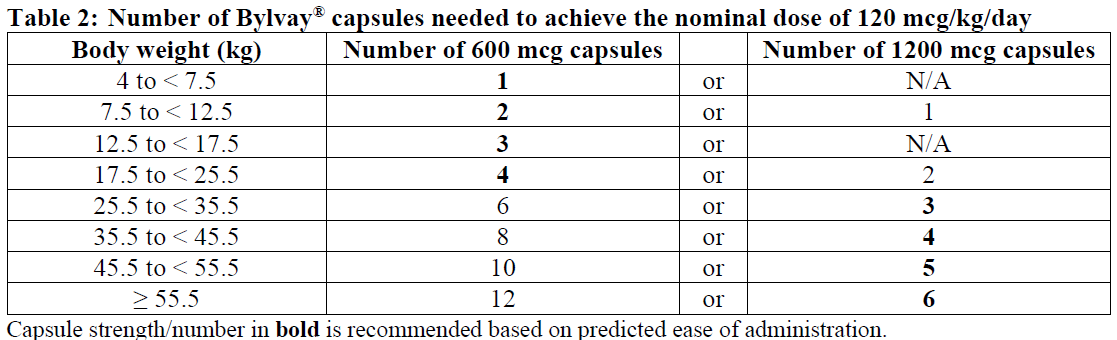
All available capsule strengths are interchangeable and may be swallowed whole or opened and sprinkled. The strength chosen to support total daily dose should be based on predicted ease of administration for each patient, i.e., total number of capsules, size of capsules, ability to swallow whole capsules.
Table 1 shows the strength and number of capsules that should be administered daily based on body weight to approximate a 40 mcg/kg/day dose.
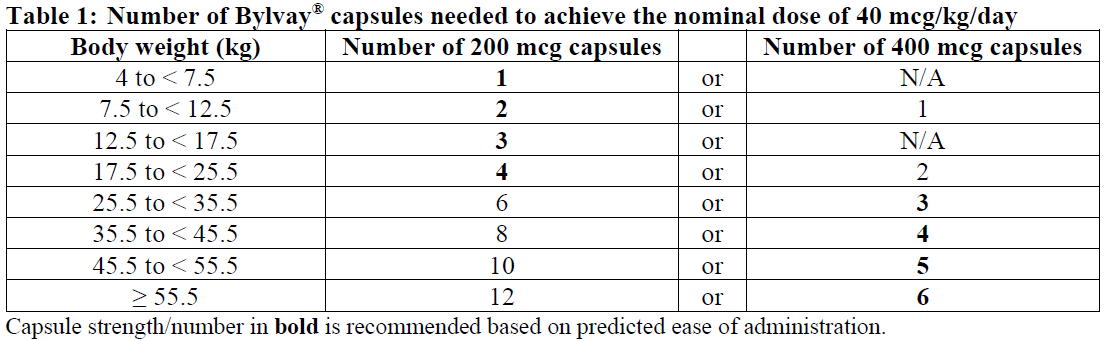
Table 2 shows the strength and number of capsules that should be administered daily based on body weight to approximate a 120 mcg/kg/day dose, with a maximum daily dose of 7200 mcg per day.
Alternative treatment should be considered in patients for whom no treatment benefit can be established following 6 months of continuous daily treatment with odevixibat.
Missed doses
If a dose of odevixibat is missed, the patient should take the forgotten dose as soon as possible without exceeding one dose per day.
Special populations
Renal impairment
There are no available clinical data for the use of odevixibat in patients with moderate or severe renal impairment or end-stage renal disease (ESRD) requiring haemodialysis (see section 5.2 – please refer to the Product Insert/Patient Information Leaflet published on HSA for the full drug information). However, due to the minimal plasma concentrations and negligible renal excretion, no dose adjustment is required for patients with renal impairment.
Hepatic impairment
No dose adjustment is required for patients with mild or moderate hepatic impairment (see sections 5.1 and 5.2 – please refer to the Product Insert/Patient Information Leaflet published on HSA for the full drug information). Odevixibat has not been sufficiently studied in patients with severe hepatic impairment (Child-Pugh C). Due to minimal absorption, no dose adjustment is required, however additional monitoring for adverse reactions may be warranted in these patients when odevixibat is administered (see section 4.4 – please refer to the Product Insert/Patient Information Leaflet published on HSA for the full drug information).
Elderly
The safety and effectiveness of Bylvay® in adult patients, including those 65 years of age and older, have not been established.
Paediatric population
The safety and efficacy of Bylvay® in patients less than 6 months of age have not been established.
Method of administration
Bylvay® is for oral use. To be taken with or without food in the morning (see section 5.2 – please refer to the Product Insert/Patient Information Leaflet published on HSA for the full drug information).
The larger 200 mcg and 600 mcg capsules are intended to be opened and sprinkled on soft food or in a liquid but may be swallowed whole.
The smaller 400 mcg and 1200 mcg capsules are intended to be swallowed whole but may be opened and sprinkled on soft food or in a liquid.
If the capsule is to be swallowed whole, the patient should be instructed to take it with a glass of water in the morning.
Administering the drug in a liquid requires the use of an oral syringe. Do not administer via a bottle or “sippy cup” because the pellets will not pass through the opening.
Pellets will not dissolve in liquids.
For capsules to be opened and sprinkled on soft food, the patient should be instructed to:
Place a small quantity (up to 30 mL/2 tablespoons) of soft food (yoghurt, apple sauce, oatmeal porridge, banana puree, carrot puree, chocolate-flavoured pudding or rice pudding) in a bowl. The food should be at or below room temperature.
Hold the capsule horizontally at both ends, twist in opposite directions and pull apart to empty the pellets into the bowl of soft food. The capsule should be gently tapped to ensure that all pellets will come out.
Repeat Step 2 if the dose requires more than one capsule.
Gently mix the pellets with a spoon into the soft food.
Administer the entire dose immediately after mixing. Do not store the mixture for future use.
Drink a glass of water following the dose.
Dispose of all empty capsule shells.
For capsules to be opened and sprinkled in a liquid (requires use of an oral dose syringe), the patient should be instructed to:
Hold the capsule horizontally at both ends, twist in opposite directions and pull apart to empty the pellets into a small mixing cup. The capsule should be gently tapped to ensure that all pellets will come out.
Repeat Step 1 if the dose requires more than one capsule.
Add 1 teaspoon (5 mL) of an age-appropriate liquid (for example, breast milk, infant formula, or water).
Let the pellets sit in the liquid for approximately 5 minutes to allow complete wetting.
After 5 minutes, place the tip of the oral syringe completely into the mixing cup. Pull the plunger of the syringe up slowly to withdraw the liquid/pellet mixture into the syringe. Gently push the plunger down again to expel the liquid/pellet mixture back into the mixing cup. Do this 2 to 3 times to ensure complete mixing of the pellets into the liquid.
Withdraw the entire contents into the oral syringe by pulling the plunger on the end of the syringe.
Place the tip of the syringe into the front of the child’s mouth between the tongue and the side of the mouth, and then gently push the plunger down to squirt the liquid/pellet mixture between the child’s tongue and the side of the mouth. Do not squirt liquid/pellet in the back of the child’s throat because this could cause gagging or choking.
If any pellet/liquid mixture remains in the mixing cup, repeat Step 6 and Step 7 until the entire dose has been administered. Do not store the mixture for future use.
Follow the dose with breast milk, infant formula or other age-appropriate liquid.
Dispose of all empty capsule shells.
Contraindications
4.3 Contraindications
Hypersensitivity to the active substance or to any of the excipients listed in section 6.1 – please refer to the Product Insert/Patient Information Leaflet published on HSA for the full drug information.