
GLUCOSE INTRAVENOUS INFUSION BP 10% [SIN06307P]
Active ingredients: GLUCOSE MONOHYDRATE
Last updated on 9 October 2026
Product Info
GLUCOSE INTRAVENOUS INFUSION BP 10%
[SIN06307P]
Product information
Active Ingredient and Strength | GLUCOSE MONOHYDRATE - 11 G/100 ML |
Dosage Form | INJECTION |
Manufacturer and Country | B BRAUN MEDICAL INDUSTRIES SDN BHD - MALAYSIA |
Registration Number | SIN06307P |
Licence Holder | B. BRAUN SINGAPORE PTE LTD |
Forensic Classification | GENERAL SALE LIST |
Anatomical Therapeutic Chemical (ATC) code | B05CX01 |
Prescription-only Medicines with Exemptions for Supply without Prescription | NA |
Indication
4.1 Therapeutic indications
– Administration of glucose for caloric support
– Vehicle solution for compatible medicinal products
Dosing
4.2 Posology and method of administration
Posology
The dosage of the solution depends on the patient’s individual glucose and fluid requirements.
Fluid balance, serum glucose, and other electrolytes may need to be monitored before and during administration, especially in patients with increased non-osmotic vasopressin release (syndrome of inappropriate antidiuretic hormone secretion, SIADH) and in patients co-medicated with vasopressin agonist drugs due to the risk of hyponatraemia.
Monitoring of serum sodium is particularly important for physiologically hypotonic fluids. Glucose B. Braun 100 mg/ml may become hypotonic after administration due to glucose metabolisation in the body (see sections 4.4. 4.5 and 4.8 – please refer to the Product Insert/Patient Information Leaflet published on HSA for the full drug information).
Vehicle solution for compatible medicinal products
The volume to be chosen depends on the desired concentration of the medicinal product for which the solution is to be used as vehicle having regard to the maximum dose stated above. The dose and administration rate depend on the properties of the prescribed additive.
Glucose for caloric support / component of parenteral nutrition
Maximum infusion rate
Adults and adolescents from 15th year of life
The maximum rate of 0.25 g of glucose per kg bodyweight per hour (4 mg glucose/kg/min) should not be exceeded in order to avoid exceeding the glucose oxidation capacity of the patient.
Paediatric population
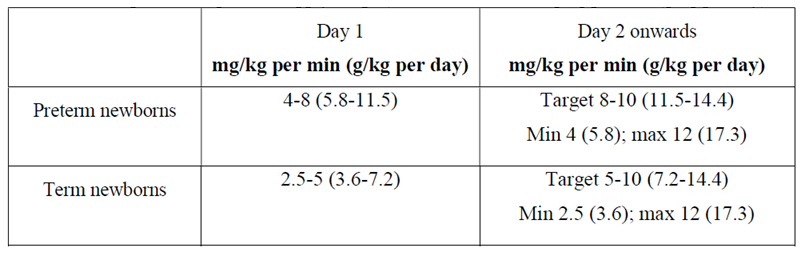
Recommended parenteral glucose supply in (pre)term newborns in mg/kg per min (g/kg per day)
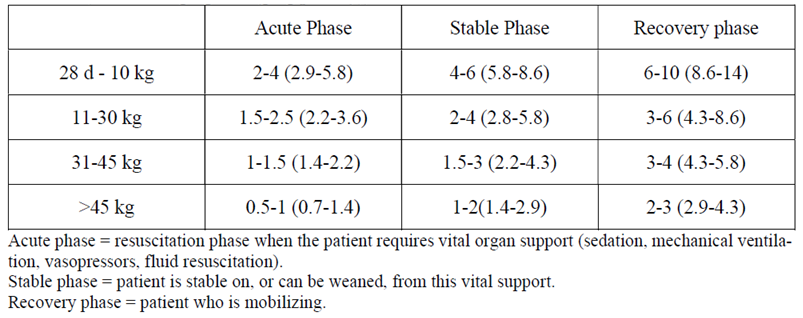
Recommended parenteral glucose supply in infants and children according to body weight and phase of illness (units are mg/kg/min (g/kg per day))
Elderly patients
Basically, the same dosage as for adults applies, but caution should be exercised in patients suffering from further diseases like cardiac insufficiency or renal insufficiency that may frequently be associated with advanced age.
Patients with impaired glucose metabolism
If the oxidative metabolism of glucose is impaired (e.g. in the early post-operative or post-traumatic period or in the presence of hypoxia or organ failure), the dosage should be adjusted to keep the blood glucose level close to normal values. Close monitoring of blood glucose levels is recommended in order to prevent hyperglycaemia.
Method of administration
Intravenous use. The solution can be infused via a large peripheral vein.
Contraindications
4.3 Contraindications
– Hypersensitivity to the active substance. See section 4.4 and 4.8 for corn allergies – please refer to the Product Insert/Patient Information Leaflet published on HSA for the full drug information
– Hyperglycaemia, not responding to insulin doses of up to 6 units insulin/hour
– Delirium tremens if such patients are already dehydrated
– Acute states of shock and collapse
– Metabolic acidosis
Since the administration of glucose solutions is accompanied by the administration of free water, further contraindications may arise e.g.:
– Hyperhydration
– Pulmonary oedema
– Acute congestive heart failure