
OCREVUS CONCENTRATE FOR SOLUTION FOR INFUSION 300MG/10ML [SIN16871P]
Active ingredients: OCRELIZUMAB
Last updated on 9 October 2026
Product Info
OCREVUS CONCENTRATE FOR SOLUTION FOR INFUSION 300MG/10ML
[SIN16871P]
Product information
Active Ingredient and Strength | OCRELIZUMAB - 300 MG/10 ML |
Dosage Form | INJECTION, SOLUTION, CONCENTRATE |
Manufacturer and Country | ROCHE DIAGNOSTICS GMBH - GERMANY |
Registration Number | SIN16871P |
Licence Holder | ROCHE SINGAPORE PTE. LTD. |
Forensic Classification | PRESCRIPTION ONLY MEDICINES |
Anatomical Therapeutic Chemical (ATC) code | L04AG08 |
Prescription-only Medicines with Exemptions for Supply without Prescription | NA |
Indication
2.1 THERAPEUTIC INDICATION(S)
Ocrevus is indicated for the treatment of adult patients with relapsing forms of multiple sclerosis (RMS) with active disease defined by clinical or imaging features, to reduce the frequency of clinical relapses and delay the progression of physical disability.
Ocrevus is indicated for the treatment of adult patients with early primary progressive multiple sclerosis (PPMS) with imaging features characteristic of inflammatory activity to delay progression of physical disability.
Dosing
2.2 DOSAGE AND ADMINISTRATION
General
Substitution by any other biological medicinal product approved in the indication requires the consent of the prescribing physician.
It is important to check the product labels to ensure that the correct formulation (Ocrevus IV or Ocrevus SC) is being administered to the patient by the correct route as prescribed. Patients may start Ocrevus treatment using Ocrevus IV or SC and patients currently receiving Ocrevus IV may continue treatment with Ocrevus IV or Ocrevus SC.
Ocrevus IV
Premedication for infusion-related reactions
Premedicate with 100 mg IV methylprednisolone (or an equivalent) approximately 30 minutes prior to each Ocrevus IV infusion (see section 2.4 Warnings and Precautions – please refer to the Product Insert/Patient Information Leaflet published on HSA for the full drug information) and with an antihistaminic drug (e.g. diphenhydramine) approximately 30–60 minutes before each infusion of Ocrevus IV to reduce the frequency and severity of infusion-related reactions.
The addition of an antipyretic (e.g. acetaminophen/paracetamol) may also be considered approximately 30–60 minutes before each infusion of Ocrevus IV.
Administration of Ocrevus
Ocrevus IV is not intended for subcutaneous administration.
Ocrevus IV is administered as an IV infusion through a dedicated line under the close supervision of an experienced healthcare professional (HCP) with access to appropriate medical support to manage severe reactions such as serious infusion-related reactions (IRRs). Ocrevus IV infusions should not be administered as an intravenous push or bolus. Use isotonic 0.9% sodium chloride solution as the infusion vehicle. In the event an IV infusion cannot be completed the same day, the remaining liquid in the infusion bag must be discarded (see section 4.1 Storage and 4.2 Special Instructions for Use, Handling and Disposal – please refer to the Product Insert/Patient Information Leaflet published on HSA for the full drug information).
Observe the patient for at least one hour after the completion of the infusion (see section 2.4.1 Warnings and Precautions, General, Infusion-Related Reactions and Injection Reactions – please refer to the Product Insert/Patient Information Leaflet published on HSA for the full drug information).
Initial Dose
Ocrevus IV is administered by IV infusion as a 600 mg dose every 6 months.
The initial 600 mg dose is administered as two separate IV infusions; first as a 300 mg infusion, followed 2 weeks later by a second 300 mg infusion.
Subsequent Doses
Subsequent doses of Ocrevus IV thereafter are administered as a single 600 mg IV infusion every 6 months (see Table 1).
If patients did not experience a serious infusion-related reaction (IRR) with any previous Ocrevus IV infusion, a shorter (2-hour) infusion can be administered for subsequent doses (see Table 1, Option 2) (see sections 2.6.1 Undesirable Effects, Clinical Trials and 3.1.2 Clinical/Efficacy Studies – please refer to the Product Insert/Patient Information Leaflet published on HSA for the full drug information).
A minimum interval of 5 months should be maintained between each dose of Ocrevus.
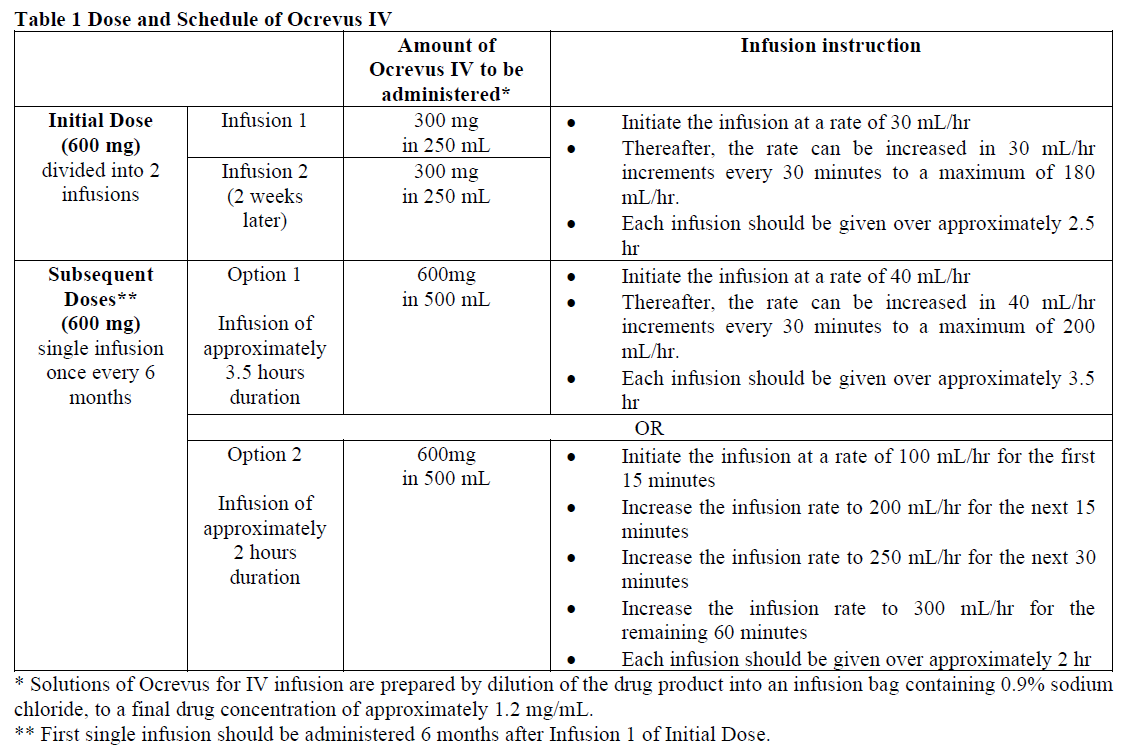
Infusion Adjustments during Treatment:
No dose reductions of Ocrevus IV are recommended.
In case of infusion-related reactions (IRRs) during any infusion, see the following adjustments. Additional information on IRRs can be found in section 2.4.1 Warnings and Precautions, General, Infusion-Related Reactions and Injection Reactions – please refer to the Product Insert/Patient Information Leaflet published on HSA for the full drug information.
Life-threatening IRRs
Immediately stop Ocrevus IV if there are signs of a life-threatening or disabling infusion-related reaction during an infusion, such as acute hypersensitivity or acute respiratory distress syndrome. The patient should receive appropriate supportive treatment.
Permanently discontinue Ocrevus IV in these patients.
Severe IRRs
If a patient experiences a severe IRR or a complex of flushing, fever, and throat pain symptoms, the infusion should be interrupted immediately and the patient should receive symptomatic treatment. The infusion should be restarted only after all symptoms have resolved. The initial infusion rate at restart should be half of the infusion rate at the time of onset of the reaction.
Mild to Moderate IRRs
If a patient experiences a mild to moderate IRR (e.g. headache), the infusion rate should be reduced to half the rate at the onset of the event. This reduced rate should be maintained for at least 30 minutes. If tolerated, the infusion rate may then be increased according to the patient’s initial infusion schedule.
See section 2.4.1 Warnings and Precautions, General, Infusion-Related Reactions and Injection Reactions for full description of symptoms associated with IRRs – please refer to the Product Insert/Patient Information Leaflet published on HSA for the full drug information.
Ocrevus SC
Premedication for injection reactions
Premedicate orally with 20 mg dexamethasone (or equivalent) and an antihistaminic drug (e.g., desloratadine) shortly before each Ocrevus SC administration (see section 2.4 Warnings and Precautions, General, Infusion-Related Reactions and Injection Reactions – please refer to the Product Insert/Patient Information Leaflet published on HSA for the full drug information) to reduce the risk of local and systemic injection reactions.
The administration of an antipyretic (e.g., acetaminophen/paracetamol) may also be considered shortly before each Ocrevus SC administration.
Administration of Ocrevus SC
Ocrevus SC is not intended for intravenous administration.
Ocrevus SC must be administered as a subcutaneous injection only, under the supervision of an HCP (see section 4.2 Special Instructions for Use, Handling and Disposal – please refer to the Product Insert/Patient Information Leaflet published on HSA for the full drug information). Prior to administration, remove Ocrevus SC from refrigeration and allow the solution to come to room temperature.
For the initial dose, post-injection monitoring with access to appropriate medical support to manage any severe injection reactions, for at least one hour after injection is recommended. For subsequent doses, the suitable administration setting (e.g., clinic or home) and post-injection monitoring is at the treating physician’s discretion.
Administer 23 mL (920 mg) of Ocrevus SC solution subcutaneously in the abdomen in approximately 10 minutes. Use of a SC infusion set (e.g., winged/butterfly) is recommended. DO NOT administer any residual hold-up volume remaining in the SC infusion set to the patient.
The injection site should be the abdomen, except for 2 inches (5 cm) around the navel. Ocrevus SC injections should not be administered into areas where the skin is red, bruised, tender or hard, or areas where there are moles or scars.
Dose and schedule
Ocrevus SC is administered as a 920 mg subcutaneous injection every 6 months.
No division of the initial dose or subsequent doses into separate administrations is required.
A minimum interval of 5 months should be maintained between each dose of Ocrevus.
Delayed or Missed Doses
If a planned dose of Ocrevus is missed, it should be administered as soon as possible; do not wait until the next planned dose. The treatment interval of 6 months (with a minimum of 5 months) for Ocrevus should be maintained between doses.
2.2.1 Special Dosage Instructions
Pediatric Use
The safety and efficacy of Ocrevus in children and adolescents (<18 years) has not been studied.
Geriatric Use
The safety and efficacy of Ocrevus in patients ≥55 years of age has not been studied.
Renal Impairment
The safety and efficacy of Ocrevus in patients with renal impairment has not been formally studied. A change in dose is not expected to be required for patients with renal impairment (see section 2.5.6 Use in Special Populations, Renal Impairment and 3.2.5 Pharmacokinetics in Special Populations, Renal Impairment – please refer to the Product Insert/Patient Information Leaflet published on HSA for the full drug information).
Hepatic Impairment
The safety and efficacy of Ocrevus in patients with hepatic impairment has not been formally studied. A change in dose is not expected to be required for patients with hepatic impairment (see section 2.5.7 Use in Special Populations, Hepatic Impairment and 3.2.5 Pharmacokinetics in Special Populations, Hepatic Impairment – please refer to the Product Insert/Patient Information Leaflet published on HSA for the full drug information).
Contraindications
2.3 CONTRAINDICATIONS
Hypersensitivity to ocrelizumab or to any of the excipients.
Severe active infection until resolution (see Section 2.4 Warnings and Precautions – please refer to the Product Insert/Patient Information Leaflet published on HSA for the full drug information).
Patients with severely immunocompromised state (see Section 2.4 Warnings and Precautions – please refer to the Product Insert/Patient Information Leaflet published on HSA for the full drug information).