LYTGOBI FILM COATED TABLETS 4MG [SIN17316P]
Active ingredients: FUTIBATINIB
Last updated on 9 October 2026
Product Info
LYTGOBI FILM COATED TABLETS 4MG
[SIN17316P]
Product information
Active Ingredient and Strength | FUTIBATINIB - 4 MG |
Dosage Form | TABLET, FILM COATED |
Manufacturer and Country | PENN PHARMACEUTICAL SERVICES, LIMITED. - UNITED KINGDOM |
Registration Number | SIN17316P |
Licence Holder | TAIHO PHARMA ASIA PACIFIC PTE. LTD. |
Forensic Classification | PRESCRIPTION ONLY MEDICINES |
Anatomical Therapeutic Chemical (ATC) code | L01EN04 |
Prescription-only Medicines with Exemptions for Supply without Prescription | NA |
Indication
4.1 Therapeutic indications
LYTGOBI monotherapy is indicated for the treatment of adult patients with locally advanced or metastatic cholangiocarcinoma with a fibroblast growth factor receptor 2 (FGFR2) fusion or rearrangement that have progressed after at least one prior line of systemic therapy.
Dosing
4.2 Posology and method of administration
LYTGOBI therapy should be initiated by a physician experienced in the diagnosis and treatment of patients with biliary tract cancer.
Presence of FGFR2 gene fusions or rearrangements should be confirmed by an appropriate diagnostic test prior to initiation of LYTGOBI therapy.
Posology
The recommended starting dose is 20 mg futibatinib taken orally once daily.
If a dose of futibatinib is missed by more than 12 hours or vomiting occurs after taking a dose, an additional dose should not be taken, and treatment should be resumed with the next scheduled dose.
Treatment should be continued until disease progression or unacceptable toxicity.
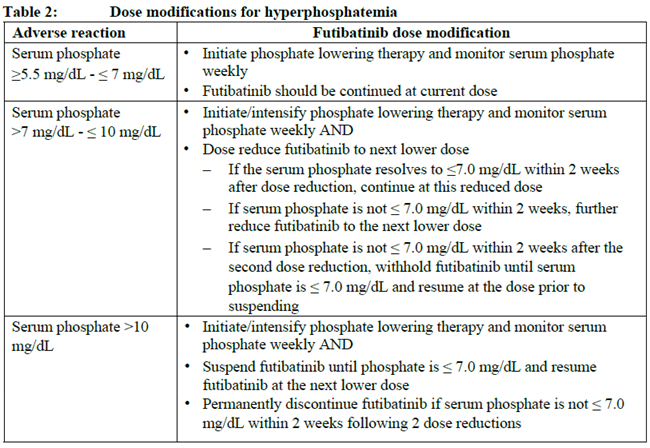
In all patients, dietary restrictions that limit phosphate intake are recommended as part of hyperphosphatemia management. A phosphate-lowering therapy should be initiated when serum phosphate level is ≥ 5.5 mg/dL. If the serum phosphate level is > 7 mg/dL, the dose of futibatinib should be modified based on the duration and severity of hyperphosphatemia (see Table 2). Prolonged hyperphosphatemia can cause soft tissue mineralization, including cutaneous calcification, vascular calcification, and myocardial calcification (see section 4.4 – please refer to the Product Insert/Patient Information Leaflet published on HSA for the full drug information).
If LYTGOBI treatment is stopped or serum phosphate level falls below normal range, phosphate-lowering therapy and diet should be discontinued. Severe hypophosphatemia may present with confusion, seizures, focal neurologic findings, heart failure, respiratory failure, muscle weakness, rhabdomyolysis, and hemolytic anemia.
Dose adjustment due to drug interaction
Concomitant use of futibatinib with strong CYP3A inhibitors
Co-administration of futibatinib with strong CYP3A4 inhibitors, such as itraconazole, should be avoided (see sections 4.4 and 4.5 – please refer to the Product Insert/Patient Information Leaflet published on HSA for the full drug information). If this is not possible, based on careful monitoring of tolerability, a futibatinib dose reduction to the next lower level should be considered.
Concomitant use of futibatinib with strong or moderate CYP3A inducers
Co-administration of futibatinib with strong or moderate CYP3A4 inducers, such as rifampicin, should be avoided (see sections 4.4 and 4.5 – please refer to the Product Insert/Patient Information Leaflet published on HSA for the full drug information). If this is not possible, gradually increasing the futibatinib dose based on careful monitoring of tolerability should be considered.
Management of toxicities
Dose modifications or interruption of dosing should be considered for the management of toxicities. The recommended dose reduction levels are provided in Table 1.

Treatment should be permanently discontinued if patient is unable to tolerate 12 mg futibatinib once daily.
Dose modifications for hyperphosphatemia are provided in Table 2.
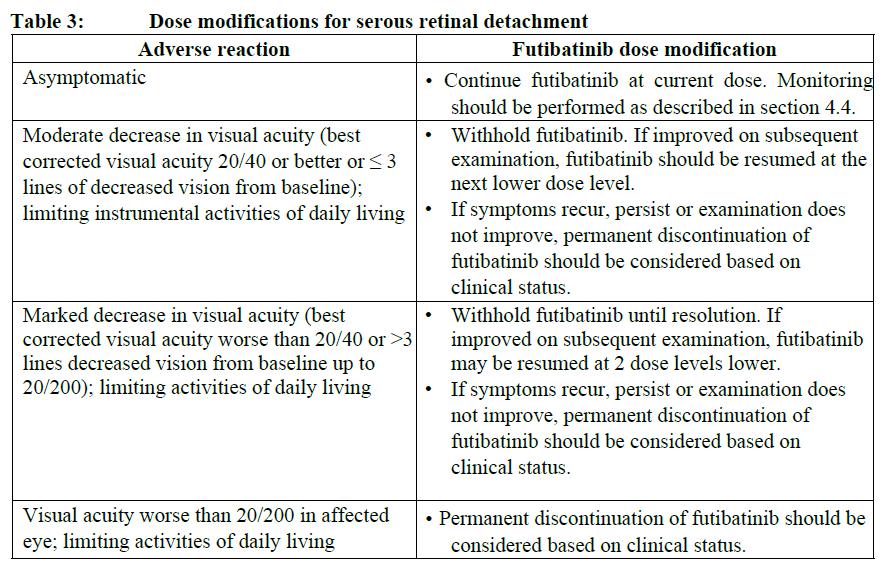
Dose modifications for serous retinal detachment are provided in Table 3.
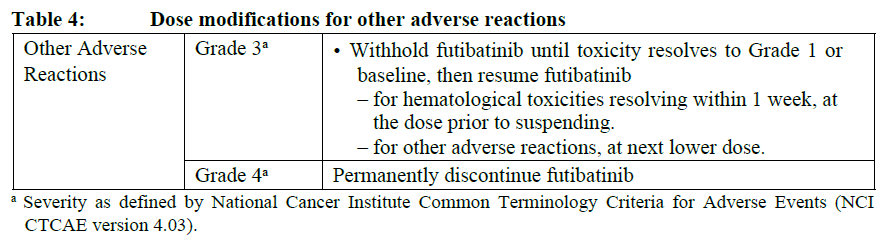
Dose modifications for other adverse reactions are provided in Table 4.
Special populations
Elderly
No specific dose adjustment is required for elderly patients (≥ 65 years) (see section 5.1 – please refer to the Product Insert/Patient Information Leaflet published on HSA for the full drug information).
Renal impairment
Dose adjustment is not required for patients with mild and moderate renal impairment (creatinine clearance [CLcr] 30 to 89 mL/min estimated by Cockcroft-Gault). There are no data in patients with severe renal impairment (CLcr < 30 mL/min) or for patients with end-stage renal disease receiving intermittent haemodialysis and therefore no dosing recommendation can be made (see section 5.2 – please refer to the Product Insert/Patient Information Leaflet published on HSA for the full drug information).
Hepatic impairment
No dose adjustment is required when administering futibatinib to patients with mild (Child-Pugh class A), moderate (Child-Pugh class B), or severe (Child-Pugh class C) hepatic impairment. However, there is no safety data in patients with severe hepatic impairment. (see section 5.2 – please refer to the Product Insert/Patient Information Leaflet published on HSA for the full drug information).
Paediatric population
The safety and efficacy of futibatinib in children less than 18 years of age have not been established. No data are available.
Method of administration
LYTGOBI is for oral use. The tablets should be taken with or without food at about the same time each day. The tablets should be swallowed whole to ensure that the full dose is administered.
Contraindications
4.3 Contraindications
Hypersensitivity to the active substance or to any of the excipients listed in section 6.1 – please refer to the Product Insert/Patient Information Leaflet published on HSA for the full drug information.