
PHENASEN CONCENTRATE FOR SOLUTION FOR INFUSION 10MG/10ML [SIN17447P]
Active ingredients: ARSENIC TRIOXIDE
Last updated on 9 October 2026
Product Info
PHENASEN CONCENTRATE FOR SOLUTION FOR INFUSION 10MG/10ML
[SIN17447P]
Product information
Active Ingredient and Strength | ARSENIC TRIOXIDE - 10 MG/10 ML |
Dosage Form | INJECTION, SOLUTION, CONCENTRATE |
Manufacturer and Country | PHEBRA PTY LTD - AUSTRALIA |
Registration Number | SIN17447P |
Licence Holder | PHEBRA (SE ASIA) PTE. LTD. |
Forensic Classification | PRESCRIPTION ONLY MEDICINES |
Anatomical Therapeutic Chemical (ATC) code | L01XX27 |
Prescription-only Medicines with Exemptions for Supply without Prescription | NA |
Indication
4.1 Therapeutic indications
Newly-diagnosed low-to-intermediate-risk acute promyelocytic leukaemia
Arsenic trioxide is indicated in combination with tretinoin for the treatment of adults with newly-diagnosed low-to-intermediate risk acute promyelocytic leukemia (APL) whose APL is characterised by the presence of the t(15:17) translocation or PML/RAR-alpha gene expression.
Relapsed or refractory acute promyelocytic leukaemia
Arsenic trioxide is indicated for the induction of remission and consolidation in patients with acute promyelocytic leukaemia (APL) who are refractory to, or have relapsed from, retinoid and anthracycline chemotherapy, and whose APL is characterised by the presence of the t(15:17) translocation or PML/RAR-alpha gene expression.
Dosing
4.2 Dose and method of administration
Recommended dosage for newly diagnosed low-to-intermediate-risk APL
A treatment course for patients with newly diagnosed low-to-intermediate-risk APL consists of 1 induction cycle and 4 consolidation cycles.
For the induction cycle, the recommended dosage of arsenic trioxide is 0.15 mg/kg intravenously daily in combination with tretinoin until bone marrow remission but not to exceed 60 days (see Table 1).
For the consolidation cycles, the recommended dosage of arsenic trioxide is 0.15 mg/kg intravenously daily 5 days per week during weeks 1–4 of each 8-week cycle for a total of 4 cycles in combination with tretinoin (see Table 1). Omit tretinoin during weeks 5–6 of the fourth cycle of consolidation.
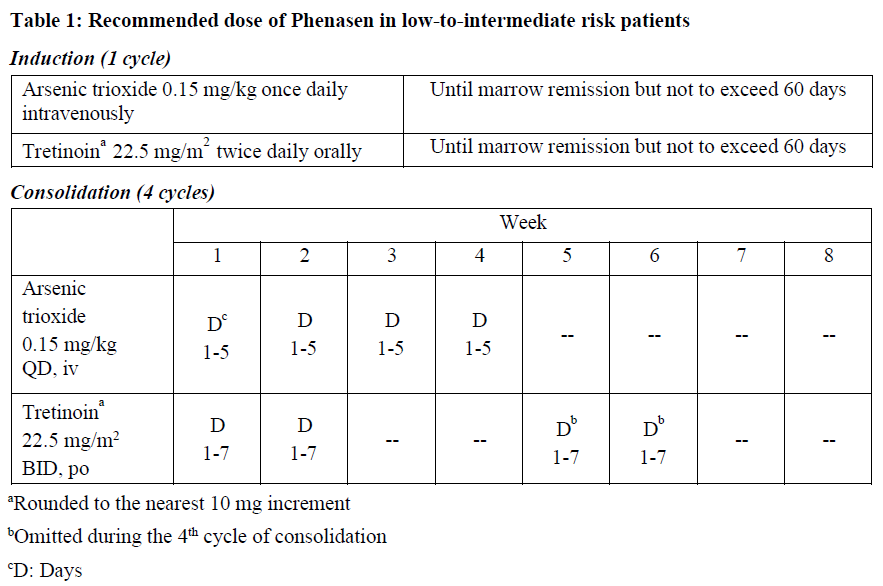
Differentiation syndrome prophylaxis consisting of prednisone 0.5 mg/kg daily from day 1 until the end of induction therapy with arsenic trioxide and tretinoin is recommended.
Recommended dosage for relapsed or refractory APL
A treatment course for patients with relapsed or refractory APL consists of 1 induction cycle and 1 consolidation cycle.
For the induction cycle, the recommended dosage of arsenic trioxide is 0.15 mg/kg/day intravenously daily until bone marrow remission or up to a maximum of 60 days.
For the consolidation cycle, the recommended dosage of arsenic trioxide is 0.15 mg/kg/day intravenously daily for 25 doses over a period of up to 5 weeks. Begin consolidation 3 to 6 weeks after completion of induction cycle.
Monitoring and dosage modifications for adverse reactions
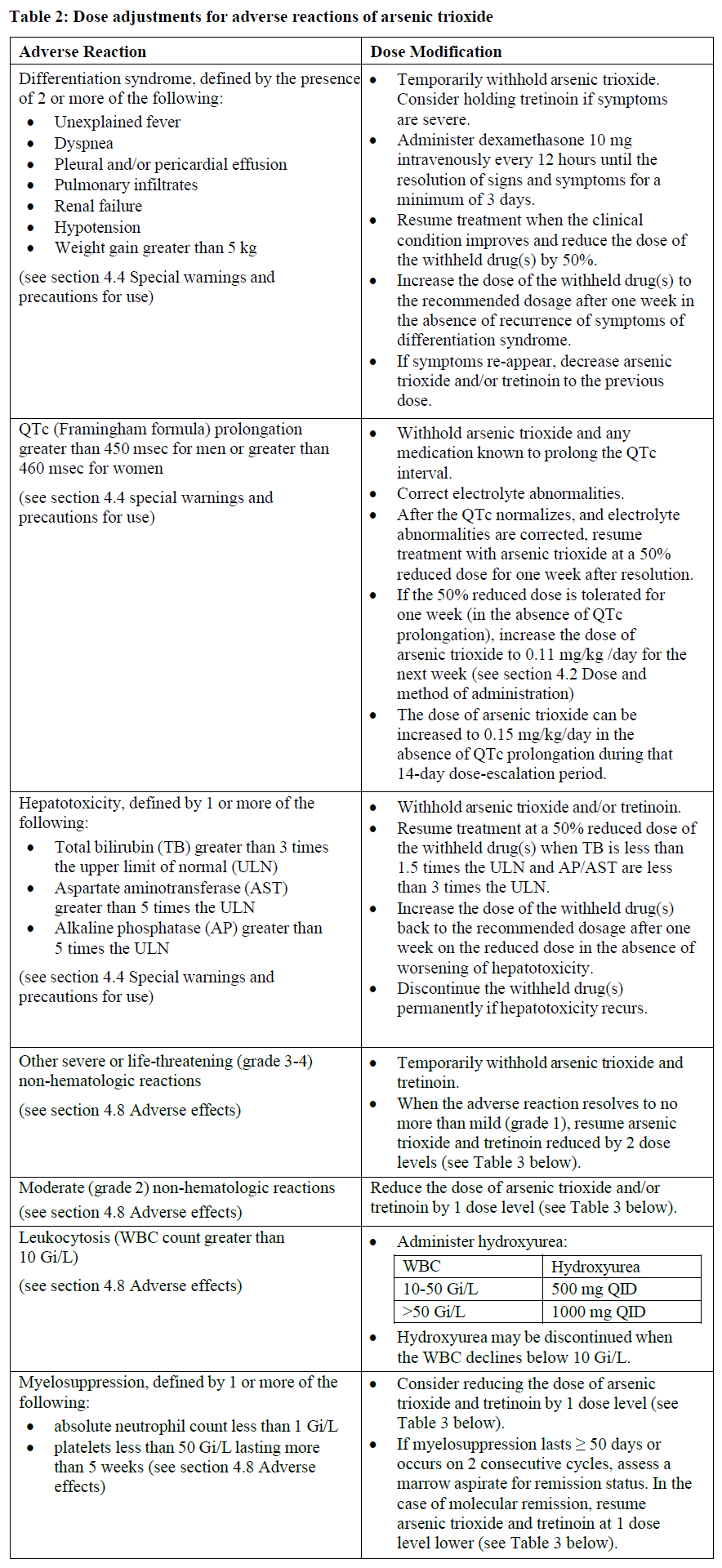
During induction, monitor coagulation studies, blood counts, and chemistries at least 2–3 times per week through recovery. During consolidation, monitor coagulation studies, blood counts, and chemistries at least weekly.
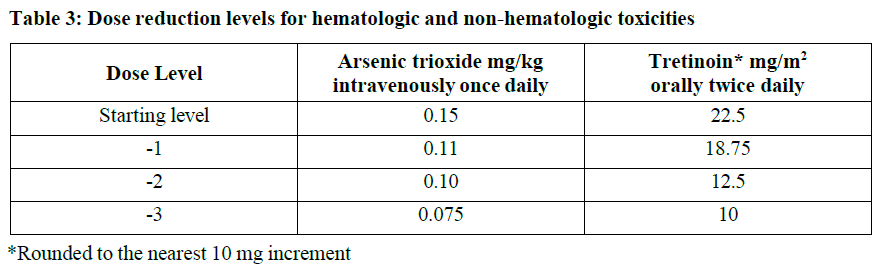
Table 2 shows the dose modifications for adverse reactions due to arsenic trioxide when used alone or in combination with tretinoin.
Preparation and administration
Phenasen must be diluted with 100 to 250 mL of 5% glucose injection or 0.9% sodium chloride injection and administered intravenously over 2 hours. The infusion duration may be extended up to 4 hours if vasomotor reactions are observed. A central venous catheter is not required.
For instructions on preparation of the medicinal product before administration, see section 6.6 Special precautions for disposal and other handling – please refer to the Product Insert/Patient Information Leaflet published on HSA for the full drug information.
Safe handling procedures
Phenasen is a cytotoxic drug. Follow applicable special handling and disposal procedures.
Incompatibilities
Phenasen is compatible with 5% glucose injection and 0.9% sodium chloride injection. In the absence of compatibility studies, this medicinal product must not be mixed with other medicinal products.
Contraindications
4.3 Contraindications
Hypersensitivity to the active substance or to any of the excipients listed in section 6.1 List of Excipients – please refer to the Product Insert/Patient Information Leaflet published on HSA for the full drug information.