
LUMAKRAS FILM-COATED TABLET 240MG [SIN17527P]
Active ingredients: SOTORASIB
Last updated 16 September 2026
Product Info
LUMAKRAS FILM-COATED TABLET 240MG
[SIN17527P]
Product information
Active Ingredient and Strength | SOTORASIB - 240 MG |
Dosage Form | TABLET, FILM COATED |
Manufacturer and Country | PATHEON INC. - CANADA |
Registration Number | SIN17527P |
Licence Holder | AMGEN BIOTECHNOLOGY SINGAPORE PTE LTD |
Forensic Classification | PRESCRIPTION ONLY MEDICINES |
Anatomical Therapeutic Chemical (ATC) code | L01XX73 |
Prescription-only Medicines with Exemptions for Supply without Prescription | NA |
Indication
1 INDICATIONS AND USAGE
1.1 KRAS G12C-mutated Locally Advanced or Metastatic Non-Small Cell Lung Cancer (NSCLC)
LUMAKRAS as a single agent is indicated for the treatment of adult patients with KRAS G12C-mutated locally advanced or metastatic non-small cell lung cancer (NSCLC), who have received at least one prior systemic therapy.
1.2 KRAS G12C-mutated Metastatic Colorectal Cancer (mCRC)
LUMAKRAS, in combination with panitumumab, is indicated for the treatment of adult patients with KRAS G12C-mutated metastatic colorectal cancer (mCRC), who have received prior fluoropyrimidine-, oxaliplatin- and irinotecan-based chemotherapy [see Dosage and Administration (2.1) and Clinical Studies (14.2) – please refer to the Product Insert/Patient Information Leaflet published on HSA for the full drug information].
Dosing
2 DOSAGE AND ADMINISTRATION
2.1 Patient Selection
KRAS G12C-mutated Locally Advanced or Metastatic NSCLC
Select patients for treatment of locally advanced or metastatic NSCLC with LUMAKRAS based on the presence of KRAS G12C mutation in tumor or plasma specimens. If no mutation is detected in a plasma specimen, test tumor tissue [see Clinical Studies (14) – please refer to the Product Insert/Patient Information Leaflet published on HSA for the full drug information].
KRAS G12C-mutated mCRC
Select patients for treatment of mCRC based on the presence of KRAS G12C mutation in tumor specimens [see Clinical Studies (14.2) – please refer to the Product Insert/Patient Information Leaflet published on HSA for the full drug information].
2.2 Recommended Dosage and Administration
LUMAKRAS as a Single Agent for KRAS G12C-mutated Locally Advanced or Metastatic NSCLC
The recommended dosage of LUMAKRAS is 960 mg (four 240 mg tablets or eight 120 mg tablets) orally once daily until disease progression or unacceptable toxicity.
LUMAKRAS in Combination with Panitumumab for KRAS G12C-mutated mCRC
The recommended dosage of LUMAKRAS is 960 mg (four 240 mg tablets or eight 120 mg tablets) orally once daily in combination with panitumumab until disease progression or unacceptable toxicity. Administer the first dose of LUMAKRAS prior to first panitumumab infusion.
Refer to the panitumumab full prescribing information for recommended panitumumab dosage information.
Take the daily dose of LUMAKRAS at the same time each day with or without food [see Clinical Pharmacology (12.3) – please refer to the Product Insert/Patient Information Leaflet published on HSA for the full drug information]. Swallow tablets whole. Do not chew, crush or split tablets. If a dose of LUMAKRAS is missed by more than 6 hours, take the next dose as prescribed the next day. Do not take 2 doses at the same time to make up for the missed dose.
If vomiting occurs after taking LUMAKRAS, do not take an additional dose. Take the next dose as prescribed the next day.
Administration to Patients Who Have Difficulty Swallowing Solids
Disperse tablets in 120 mL (4 ounces) of non-carbonated, room-temperature water without crushing. No other liquids should be used. Stir or swirl the cup for approximately 3 minutes until tablets are dispersed into small pieces (the tablets will not completely dissolve) and drink immediately or within 2 hours. The appearance of the mixture may range from pale yellow to bright yellow. Swallow the tablet dispersion. Do not chew pieces of the tablet. Rinse the container with an additional 120 mL (4 ounces) of water and drink. If the mixture is not consumed immediately, stir the mixture again to ensure that tablets are dispersed.
If administration through a nasogastric (NG) tube or percutaneous endoscopic gastrostomy (PEG) tube is required, follow the process above for the initial dispersion and for the residual rinse of the 240 mg or 120 mg tablets. The resulting dispersed suspension and rinse should be administered as per the NG or PEG tube manufacturer's instructions with appropriate water flushes. Administer within two hours of preparation, stored at room temperature.
2.3 Dosage Modifications for Adverse Reactions
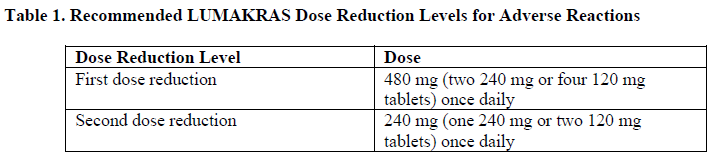
LUMAKRAS dose reduction levels are summarized in Table 1.
If adverse reactions occur, a maximum of two dose reductions are permitted. Discontinue LUMAKRAS if patients are unable to tolerate the minimum dose of 240 mg once daily.
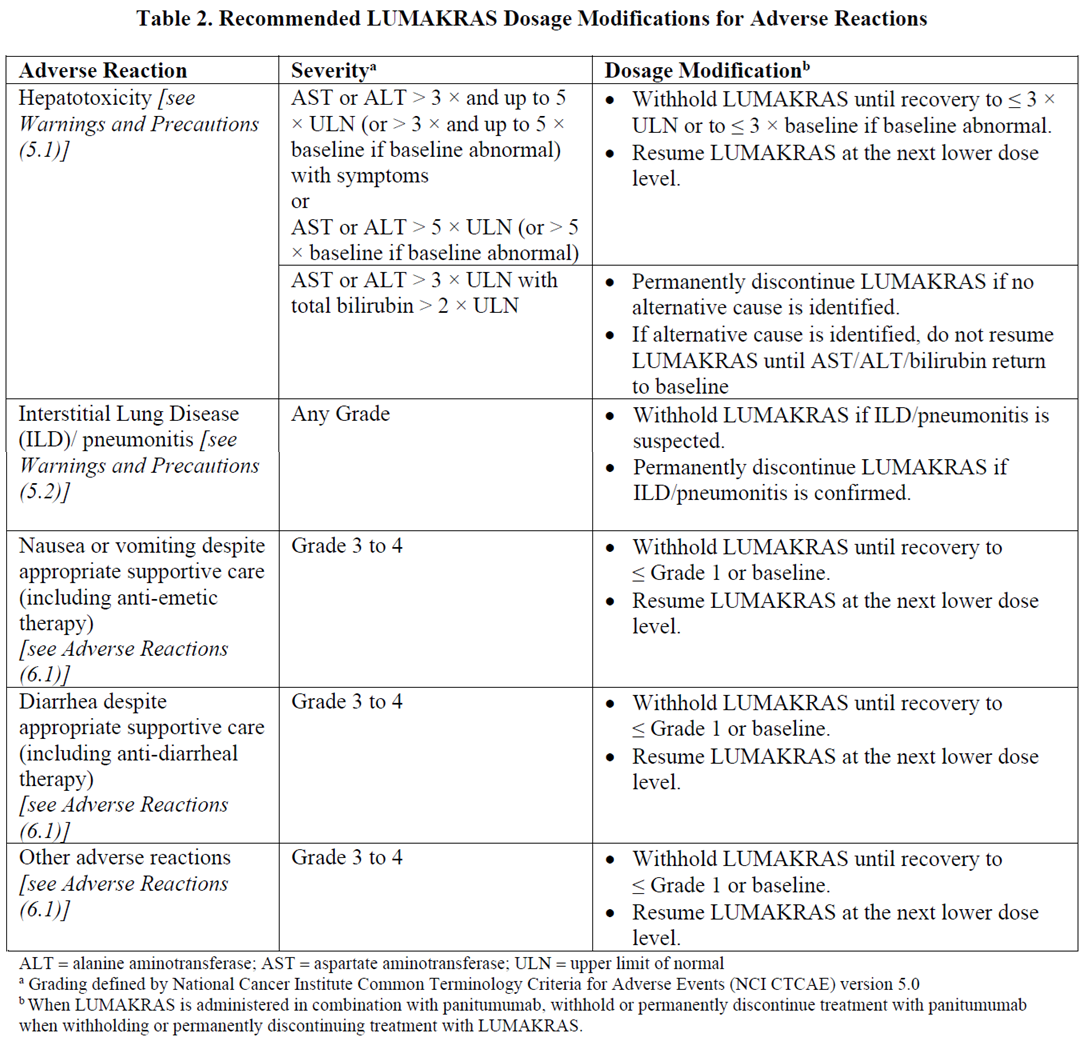
When LUMAKRAS is administered in combination with panitumumab, and LUMAKRAS is temporarily withheld or permanently discontinued, temporarily withhold or permanently discontinue panitumumab, respectively [see Clinical Studies (14.2) – please refer to the Product Insert/Patient Information Leaflet published on HSA for the full drug information]. Refer to the full prescribing information of panitumumab for dose modifications for adverse reactions associated with the use of panitumumab.
Treatment with LUMAKRAS as a single agent may be continued if panitumumab is permanently discontinued [see Clinical Pharmacology (12.1), Clinical Studies (14.2) – please refer to the Product Insert/Patient Information Leaflet published on HSA for the full drug information].
Refer to Table 2 for dose modification guidelines and management of adverse reactions associated with the use of LUMAKRAS as a single agent or as combination therapy with panitumumab.
2.4 Coadministration of LUMAKRAS with Acid-Reducing Agents
Avoid coadministration of proton pump inhibitors (PPIs) and H2 receptor antagonists with LUMAKRAS. If treatment with an acid-reducing agent cannot be avoided, take LUMAKRAS 4 hours before or 10 hours after administration of a local antacid [see Drug Interactions (7.1) and Clinical Pharmacology (12.3) – please refer to the Product Insert/Patient Information Leaflet published on HSA for the full drug information].
Contraindications
4 CONTRAINDICATIONS
None.