
YESINTEK SOLUTION FOR INJECTION IN PRE-FILLED SYRINGE 45MG/0.5ML [SIN17569P]
Active ingredients: USTEKINUMAB
Last updated 16 September 2026
Product Info
YESINTEK SOLUTION FOR INJECTION IN PRE-FILLED SYRINGE 45MG/0.5ML
[SIN17569P]
Product information
Active Ingredient and Strength | USTEKINUMAB - 45 MG/0.5 ML |
Dosage Form | INJECTION, SOLUTION |
Manufacturer and Country | BIOCON BIOLOGICS LIMITED - INDIA |
Registration Number | SIN17569P |
Licence Holder | CEDAR PHARMACEUTICALS PTE. LTD. |
Forensic Classification | PRESCRIPTION ONLY MEDICINES |
Anatomical Therapeutic Chemical (ATC) code | L04AC05 |
Prescription-only Medicines with Exemptions for Supply without Prescription | NA |
Indication
4.1 Therapeutic indications
Plaque psoriasis
Yesintek is indicated for the treatment of moderate to severe plaque psoriasis in adults who failed to respond to, or who have a contraindication to, or are intolerant to other systemic therapies including ciclosporin, methotrexate (MTX) or PUVA (psoralen and ultraviolet A) (see section 5.1 – please refer to the Product Insert/Patient Information Leaflet published on HSA for the full drug information).
Paediatric plaque psoriasis
Yesintek is indicated for the treatment of moderate to severe plaque psoriasis in children and adolescent patients from the age of 6 years and older, who are inadequately controlled by, or are intolerant to, other systemic therapies or phototherapies (see section 5.1 – please refer to the Product Insert/Patient Information Leaflet published on HSA for the full drug information).
Psoriatic arthritis (PsA)
Yesintek alone or in combination with methotrexate (MTX), is indicated for: the treatment of adult patients (18 years or older) with active psoriatic arthritis when the response to previous non-biological disease-modifying anti-rheumatic drug (DMARD) therapy has been inadequate inhibiting the progression of structural damage (see section 5.1 – please refer to the Product Insert/Patient Information Leaflet published on HSA for the full drug information).
Crohn’s Disease
Yesintek is indicated for the treatment of adults with moderately to severe active Crohn’s disease who have: failed or were intolerant to treatment with immunomodulators or corticosteroids, but never failed treatment with a tumor necrosis factor (TNF) blocker or failed or were intolerant to treatment with one or more TNF blockers
Dosing
4.2 Posology and method of administration
Yesintek is intended for use under the guidance and supervision of physicians experienced in the diagnosis and treatment of conditions for which Yesintek is indicated.
Posology
Plaque psoriasis
The recommended posology of Yesintek is an initial dose of 45 mg administered subcutaneously, followed by a 45 mg dose 4 weeks later, and then every 12 weeks thereafter.
Consideration should be given to discontinuing treatment in patients who have shown no response up to 28 weeks of treatment.
Patients with body weight > 100 kg
For patients with a body weight > 100 kg the initial dose is 90 mg administered subcutaneously, followed by a 90 mg dose 4 weeks later, and then every 12 weeks thereafter. In these patients, 45 mg was also shown to be efficacious. However, 90 mg resulted in greater efficacy. (see section 5.1, Table 4 – please refer to the Product Insert/Patient Information Leaflet published on HSA for the full drug information)
Psoriatic arthritis (PsA)
The recommended posology of Yesintek is an initial dose of 45 mg administered subcutaneously, followed by a 45 mg dose 4 weeks later, and then every 12 weeks thereafter. Alternatively, 90 mg may be used in patients with a body weight > 100 kg.
Consideration should be given to discontinuing treatment in patients who have shown no response up to 28 weeks of treatment.
Elderly
No dose adjustment is needed for patients aged 65 years and older (see section 4.4 – please refer to the Product Insert/Patient Information Leaflet published on HSA for the full drug information).
Renal and hepatic impairment
Yesintek has not been studied in these patient populations. No dose recommendations can be made.
Paediatric population
The safety and efficacy of Yesintek in children with psoriasis less than 6 years of age or in children with psoriatic arthritis less than 18 years of age have not yet been established.
Paediatric plaque psoriasis
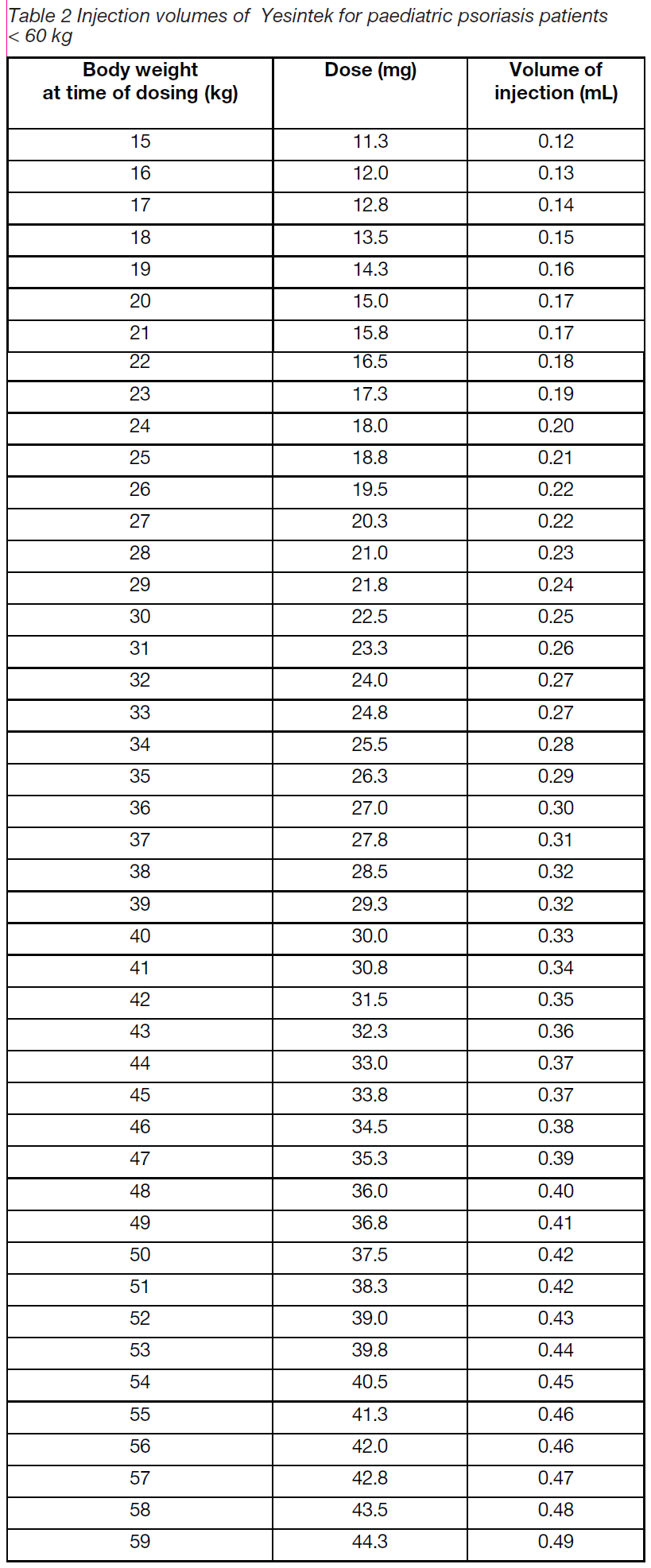
The recommended dose of Yesintek for 6 years and older based on body weight is shown below (Tables 1 and 2). Yesintek should be administered at Weeks 0 and 4, then every 12 weeks thereafter
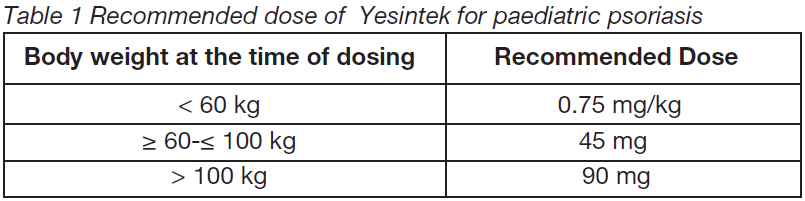
To calculate the volume of injection (mL) for patients < 60 kg, use the following formula: body weight (kg) x 0.0083 (mL/kg) or see Table 2. The calculated volume should be rounded to the nearest 0.01 mL and administered using a 1 mL graduated syringe. A 45 mg vial is available for paediatric patients who need to receive less than the full 45mg dose.
Consideration should be given to discontinuing treatment in patients who have shown no response up to 28 weeks of treatment.
Crohn’s Disease
In the treatment regimen, the first dose of Yesintek is administered intravenously. For the posology of the intravenous dosing regimen, see section 4.2 of the Yesintek 130 mg Concentrate for solution for infusion SmPC.
The first subcutaneous administration of 90 mg Yesintek should take place at week 8 after the intravenous dose. After this, dosing every 12 weeks is recommended.
Patients who have not shown adequate response at 8 weeks after the first subcutaneous dose, may receive a second subcutaneous dose at this time (see section 5.1 – please refer to the Product Insert/Patient Information Leaflet published on HSA for the full drug information).
Patients who lose response on dosing every 12 weeks may benefit from an increase in dosing frequency to every 8 weeks (see section 5.1, section 5.2 – please refer to the Product Insert/Patient Information Leaflet published on HSA for the full drug information).
Patients may subsequently be dosed every 8 weeks or every 12 weeks according to clinical judgment (see section 5.1 – please refer to the Product Insert/Patient Information Leaflet published on HSA for the full drug information).
Consideration should be given to discontinuing treatment in patients who show no evidence of therapeutic benefit 16 weeks after the IV induction dose or 16 weeks after switching to the 8-weekly maintenance dose.
Immunomodulators and/or corticosteroids may be continued during treatment with Yesintek. In patients who have responded to treatment with Yesintek, corticosteroids may be reduced or discontinued in accordance with standard of care.
In Crohn’s disease if therapy is interrupted, resumption of treatment with subcutaneous dosing every 8 weeks is safe and effective.
Elderly
No dose adjustment is needed for for patients aged 65 years and older (see section 4.4 – please refer to the Product Insert/Patient Information Leaflet published on HSA for the full drug information)
Renal and hepatic impairment
Ustekinumab has not been studied in these patient populations. No dose recommendations can be made.
Paediatric population
The safety and efficacy of Ustekinumab in treatment of Crohn’s disease in children less than 18 years have not yet been established. No data are available.
Method of administration
Yesintek 45 mg vials or 45 mg and 90 mg pre-filled syringes are for subcutaneous injection only. If possible, areas of the skin that show psoriasis should be avoided as injection sites.
After proper training in subcutaneous injection technique, patients or their caregivers may inject Yesintek if a physician determines that it is appropriate. However, the physician should ensure appropriate follow-up of patients. Patients or their caregivers should be instructed to inject the prescribed amount of Yesintek according to the directions provided in the package leaflet.
Comprehensive instructions for administration are given in the package leaflet.
For further instructions on preparation and special precautions for handling, see section 6.6 – please refer to the Product Insert/Patient Information Leaflet published on HSA for the full drug information.
Contraindications
4.3 Contraindications
Hypersensitivity to the active substance or to any of the excipients listed in section 6.1 – please refer to the Product Insert/Patient Information Leaflet published on HSA for the full drug information.
Clinically important, active infection (e.g. active tuberculosis; see section 4.4 – please refer to the Product Insert/Patient Information Leaflet published on HSA for the full drug information).