
BLENREP POWDER FOR CONCENTRATE FOR SOLUTION FOR INFUSION 100 MG/ VIAL [SIN17592P]
Active ingredients: BELANTAMAB MAFODOTIN
Last updated on 9 October 2026
Product Info
BLENREP POWDER FOR CONCENTRATE FOR SOLUTION FOR INFUSION 100 MG/ VIAL
[SIN17592P]
Product information
Active Ingredient and Strength | BELANTAMAB MAFODOTIN - 100 MG/VIAL |
Dosage Form | INJECTION, POWDER, LYOPHILIZED, FOR SOLUTION |
Manufacturer and Country | GLAXOSMITHKLINE MANUFACTURING SPA - ITALY |
Registration Number | SIN17592P |
Licence Holder | GLAXOSMITHKLINE PTE LTD |
Forensic Classification | PRESCRIPTION ONLY MEDICINES |
Anatomical Therapeutic Chemical (ATC) code | L01FX15 |
Prescription-only Medicines with Exemptions for Supply without Prescription | NA |
Indication
Indications
BLENREP is indicated for the treatment of adults with relapsed or refractory multiple myeloma:
in combination with bortezomib and dexamethasone in patients who have received at least one prior therapy; and
in combination with pomalidomide and dexamethasone in patients who have received at least one prior therapy including lenalidomide.
Dosing
Dosage and Administration
Pharmaceutical form: Powder for concentrate for solution for infusion.
Treatment with BLENREP should be initiated and supervised by physicians experienced in the treatment of multiple myeloma.
Method of Administration
BLENREP is a cytotoxic anticancer medicinal product. Proper handling procedures should be followed. Instructions on reconstitution and further dilution are provided in Use and Handling – please refer to the Product Insert/Patient Information Leaflet published on HSA for the full drug information.
BLENREP is administered as an intravenous infusion over approximately 30 minutes.
Recommended Supportive Care
Patients should have an ophthalmic examination (including visual acuity and slit lamp examination) performed by an eye care professional, prior to each dose of BLENREP or more frequently as clinically indicated. If changes in vision or corneal signs are not observed at or before the sixth dose, ophthalmic examination frequency may be reduced to approximately every 3 months and whenever clinically indicated (see Warnings and Precautions – please refer to the Product Insert/Patient Information Leaflet published on HSA for the full drug information).
Physicians should encourage patients to inform them of any ocular symptoms.
Additionally, they should advise patients to administer preservative-free artificial tears at least 4 times a day beginning on the first day of infusion and continuing until completion of treatment as this may reduce ocular symptoms (see Warnings and Precautions – please refer to the Product Insert/Patient Information Leaflet published on HSA for the full drug information).
For patients with dry eye symptoms, additional therapies may be considered as recommended by their eye care professional.
Adults
Administration of BLENREP should be continued until disease progression or unacceptable toxicity.
Combination with other therapies
The recommended starting dose schedule of BLENREP in combination with other therapies is presented in Table 1.
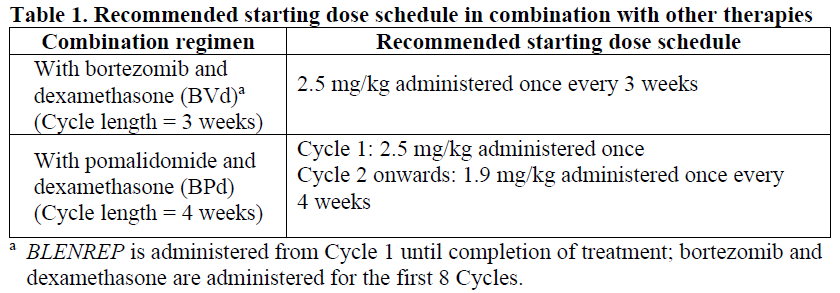
For dosing instructions of therapies administered in combination with BLENREP, refer to Clinical Studies – please refer to the Product Insert/Patient Information Leaflet published on HSA for the full drug information and respective Prescribing Information, as appropriate .
Dose Modifications
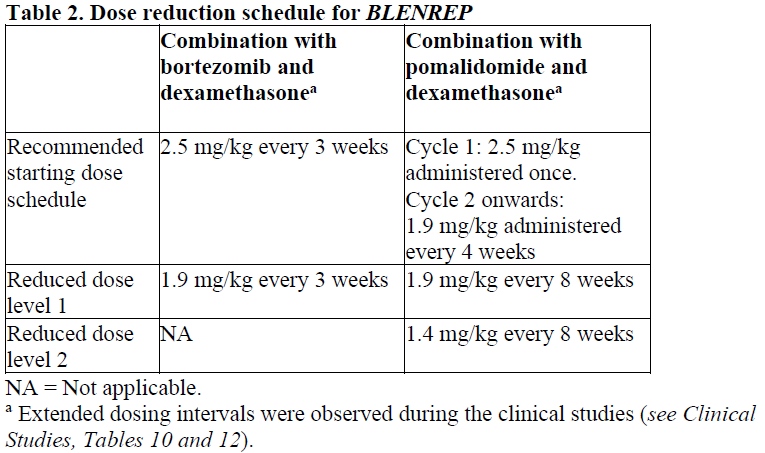
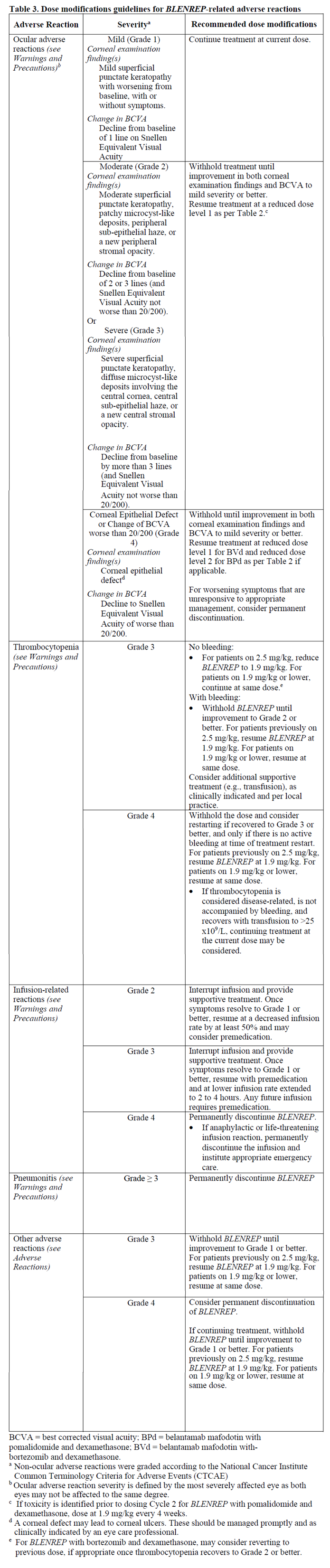
The dosage of BLENREP should be individualised for each patient. Recommended dose modifications are provided in Tables 2 and 3 for adverse reactions.
Ocular events were graded based on ophthalmic examination findings that include the combination of corneal examination findings and best corrected visual acuity (BCVA).
The treating physician should review the patient’s ophthalmic examination findings before dosing and determine the dose of BLENREP based on the results (Table 3).
During the ophthalmic examination, the eye care professional should assess the following:
The corneal examination finding(s) and the decline in BCVA.
If there is a decline in BCVA, the relationship to BLENREP should be determined.
The category grading for these examination findings and BCVA should be communicated to the treating physician.
The corneal examination findings may or may not be accompanied by changes in BCVA.
Note: One eye may be more severely affected than the other. It is important for physicians to consider not only corneal examination findings but also visual acuity changes and reported symptoms as they evaluate dose delays and reductions.
Do not re-escalate the BLENREP dose after a dose reduction is made for ocular adverse reactions.
Children
The safety and efficacy of BLENREP have not been established in children less than 18 years of age.
Elderly
No dosage adjustment is required in patients over 65 years of age (see Pharmacokinetics – Special Patient Populations – please refer to the Product Insert/Patient Information Leaflet published on HSA for the full drug information).
Renal impairment
No dose adjustment is required in patients with mild, moderate or severe renal impairment or kidney failure (eGFR <30 mL/min) (see Pharmacokinetics – Special Patient Populations – please refer to the Product Insert/Patient Information Leaflet published on HSA for the full drug information).
Hepatic impairment
No dose adjustment is required in patients with mild hepatic impairment (total bilirubin greater than ULN to ≤ 1.5 × ULN and any aspartate transaminase [AST] or total bilirubin ≤ ULN with AST > ULN). There are limited data in patients with moderate hepatic impairment and no data in patients with severe hepatic impairment to support a dose recommendation (see Pharmacokinetics – Special Patient Populations – please refer to the Product Insert/Patient Information Leaflet published on HSA for the full drug information).
Contraindications
Contraindications
Hypersensitivity to the active substance or to any of the excipients listed in List of Excipients – please refer to the Product Insert/Patient Information Leaflet published on HSA for the full drug information.