
KEYTRUDA SC SOLUTION FOR INJECTION 165MG/ML [SIN17657P]
Active ingredients: PEMBROLIZUMAB
Last updated on 20 November 2026
Product Info
KEYTRUDA SC SOLUTION FOR INJECTION 165MG/ML
[SIN17657P]
Product information
Active Ingredient and Strength | PEMBROLIZUMAB - 165 MG/ML |
Dosage Form | INJECTION, SOLUTION |
Manufacturer and Country | BSP PHARMACEUTICALS S.P.A. - ITALY |
Registration Number | SIN17657P |
Licence Holder | MSD PHARMA (SINGAPORE) PTE. LTD. |
Forensic Classification | PRESCRIPTION ONLY MEDICINES |
Anatomical Therapeutic Chemical (ATC) code | L01FF02 |
Prescription-only Medicines with Exemptions for Supply without Prescription | NA |
Indication
1. INDICATIONS AND USAGE
Melanoma
KEYTRUDA SC (pembrolizumab) is indicated for the treatment of adult patients with unresectable or metastatic melanoma.
KEYTRUDA SC is indicated for the adjuvant treatment of adult and pediatric patients 12 years and older with Stage IIB, IIC, or III melanoma who have undergone complete resection.
Non-Small Cell Lung Carcinoma
KEYTRUDA SC, in combination with pemetrexed and platinum chemotherapy, is indicated for the first-line treatment of adult patients with metastatic non-squamous non-small cell lung carcinoma (NSCLC), with no EGFR or ALK genomic tumor aberrations.
KEYTRUDA SC, in combination with carboplatin and either paclitaxel or nab-paclitaxel, is indicated for the first-line treatment of adult patients with metastatic squamous NSCLC.
KEYTRUDA SC as monotherapy is indicated for the first-line treatment of adult patients with metastatic NSCLC whose tumors express PD-L1 with a ≥ 50% tumor proportion score (TPS) as determined by a validated test, with no EGFR or ALK genomic tumor aberrations.
KEYTRUDA SC as monotherapy is indicated for the treatment of adult patients with locally advanced or metastatic NSCLC whose tumors express PD-L1 with a ≥ 1% TPS as determined by a validated test and who have received platinum-containing chemotherapy. Patients with EGFR or ALK genomic tumor aberrations should have received prior therapy for these aberrations prior to receiving KEYTRUDA SC.
KEYTRUDA SC is indicated for the treatment of adult patients with resectable Stage II, IIIA, or IIIB (T3-4N2) NSCLC in combination with platinum-containing chemotherapy as neoadjuvant treatment, and then continued as monotherapy as adjuvant treatment.
KEYTRUDA SC as monotherapy is indicated as adjuvant treatment following resection and platinum-based chemotherapy for adults patients with Stage IB (T2a ≥ 4 cm), II, or IIIA NSCLC.
Malignant Pleural Mesothelioma
KEYTRUDA SC, in combination with pemetrexed and platinum chemotherapy, is indicated for the first-line treatment of adult patients with unresectable non-epithelioid malignant pleural mesothelioma (MPM).
Head and Neck Cancer
KEYTRUDA SC is indicated for the treatment of adult patients with resectable locally advanced head and neck squamous cell carcinoma (HNSCC) whose tumours express PD-L1 with a CPS ≥ 1 as determined by a validated test, as neoadjuvant treatment, continued as adjuvant treatment in combination with radiotherapy (RT) with or without cisplatin and then as monotherapy.
KEYTRUDA SC, as monotherapy or in combination with platinum and 5-fluorouracil (5-FU) chemotherapy, is indicated for the first-line treatment of adult patients with metastatic or unresectable recurrent HNSCC whose tumours express PD-L1 with a CPS ≥ 1.
Classical Hodgkin Lymphoma
KEYTRUDA SC is indicated for the treatment of adult and pediatric patients 12 years and older with relapsed or refractory classical Hodgkin lymphoma (cHL), who have failed autologous stem cell transplant (ASCT) or following at least two prior therapies when ASCT is not a treatment option.
Urothelial Carcinoma
KEYTRUDA SC, in combination with enfortumab vedotin, is indicated for the treatment of adult patients with locally advanced or metastatic urothelial carcinoma.
KEYTRUDA SC, as monotherapy, is indicated for the treatment of adult patients with locally advanced or metastatic urothelial carcinoma whose tumours express PD-L1 with a combined positive score (CPS) ≥ 10 as determined by a validated test, and who are not eligible for cisplatin-containing chemotherapy.
KEYTRUDA SC, as monotherapy, is indicated for the treatment of adult patients with locally advanced or metastatic urothelial carcinoma who have received prior platinum-containing chemotherapy.
KEYTRUDA SC, in combination with enfortumab vedotin, as neoadjuvant treatment and then continued after radical cystectomy as adjuvant treatment, is indicated for the treatment of patients with resectable muscle invasive bladder cancer (MIBC) who are ineligible for cisplatin-containing chemotherapy.
Gastric Cancer
KEYTRUDA SC, in combination with fluoropyrimidine- and platinum-containing chemotherapy, is indicated for the first-line treatment of adult patients with locally advanced unresectable or metastatic HER2-negative gastric or gastroesophageal junction (GEJ) adenocarcinoma.
KEYTRUDA SC, in combination with trastuzumab, fluoropyrimidine- and platinum-containing chemotherapy, is indicated for the first-line treatment of adult patients with locally advanced unresectable or metastatic HER2-positive gastric or gastroesophageal junction (GEJ) adenocarcinoma, whose tumors express PD-L1 [Combined Positive Score (CPS) ≥ 1] as determined by a validated test.
Esophageal Cancer
KEYTRUDA SC, in combination with platinum and fluoropyrimidine based chemotherapy, is indicated for the first-line treatment of adult patients with locally advanced or metastatic carcinoma of the esophagus or HER2 negative gastroesophageal junction (GEJ) adenocarcinoma (tumors with epicenter 1 to 5 centimeters above the GEJ) that is not amenable to surgical resection or definitive chemoradiation.
Colorectal Cancer
KEYTRUDA SC is indicated for the first-line treatment of adult patients with metastatic microsatellite instability-high (MSI-H) or mismatch repair deficient (dMMR) colorectal cancer (CRC).
Hepatocellular Carcinoma
KEYTRUDA SC is indicated for the treatment of adult patients with hepatocellular carcinoma (HCC) who have been previously treated with an anti-angiogenic tyrosine kinase inhibitor (TKI).
Biliary Tract Carcinoma
KEYTRUDA SC, in combination with gemcitabine and cisplatin, is indicated for the treatment of adult patients with locally advanced unresectable or metastatic biliary tract carcinoma (BTC).
Cervical Cancer
KEYTRUDA SC, in combination with chemoradiotherapy (CRT), is indicated for the treatment of adult patients with FIGO 2014 Stage III–IVA locally advanced cervical cancer.
KEYTRUDA SC, in combination with chemotherapy with or without bevacizumab, is indicated for the treatment of adult patients with persistent, recurrent, or metastatic cervical cancer whose tumours express PD-L1 with a CPS ≥ 1 [see Clinical Studies (9) – please refer to the Product Insert/Patient Information Leaflet published on HSA for the full drug information].
Renal Cell Carcinoma
KEYTRUDA SC, in combination with axitinib, is indicated for the first-line treatment of adult patients with advanced renal cell carcinoma (RCC).
KEYTRUDA SC, in combination with lenvatinib, is indicated for the first-line treatment of adult patients with advanced RCC.
KEYTRUDA SC, as monotherapy, is indicated for the adjuvant treatment of adult patients with RCC at increased risk of recurrence following nephrectomy, or following nephrectomy and resection of metastatic lesions [see Clinical Studies (9) – please refer to the Product Insert/Patient Information Leaflet published on HSA for the full drug information].
Endometrial Carcinoma
KEYTRUDA SC, in combination with carboplatin and paclitaxel, followed by KEYTRUDA SC as monotherapy, is indicated for the treatment of adult patients with primary advanced or recurrent endometrial carcinoma who are candidates for systemic therapy.
KEYTRUDA SC, in combination with lenvatinib, is indicated for the treatment of adult patients with advanced endometrial carcinoma who have disease progression following prior systemic therapy in any setting and are not candidates for curative surgery or radiation.
Triple-Negative Breast Cancer
KEYTRUDA SC is indicated for the treatment of adult patients with high-risk early-stage triple-negative breast cancer (TNBC) in combination with chemotherapy as neoadjuvant treatment, and then continued as monotherapy as adjuvant treatment after surgery.
KEYTRUDA SC, in combination with chemotherapy, is indicated for the treatment of adult patients with locally recurrent unresectable or metastatic TNBC whose tumors express PD-L1 (CPS ≥ 10) as determined by a validated test and who have not received prior chemotherapy for metastatic disease [see Clinical Studies (9) – please refer to the Product Insert/Patient Information Leaflet published on HSA for the full drug information].
Dosing
2. DOSAGE AND ADMINISTRATION
2.1 General
Patient Selection
For single-agent treatment of Non-Small Cell Lung Carcinoma, Urothelial Carcinoma, or Colorectal Cancer.
Select patients for treatment with KEYTRUDA SC based on the presence of positive PD-L1 expression using a validated test [see Clinical Studies (9) – please refer to the Product Insert/Patient Information Leaflet published on HSA for the full drug information] in:
locally advanced or metastatic NSCLC.
locally advanced or metastatic urothelial carcinoma who are not eligible for cisplatin-containing chemotherapy.
Select patients for treatment with KEYTRUDA SC based on microsatellite instability-high cancer (MSI-H) or mismatch repair deficient (dMMR) tumor status [see Clinical Studies (9) – please refer to the Product Insert/Patient Information Leaflet published on HSA for the full drug information] in:
metastatic CRC.
For treatment of TNBC or gastric cancer in combination with chemotherapy
Select patients for treatment with KEYTRUDA SC based on the presence of positive PD-L1 expression using a validated test [see Clinical Studies (9) – please refer to the Product Insert/Patient Information Leaflet published on HSA for the full drug information] in:
locally recurrent unresectable or metastatic TNBC.
locally advanced unresectable or metastatic HER2-positive gastric or gastroesophageal junction (GEJ) adenocarcinoma.
For treatment of HNSCC in combination with radiotherapy, with or without chemotherapy
Resectable locally advanced HNSCC, PD-L1 expression should be evaluated using a fully validated test.
For treatment of cervical cancer in combination with chemotherapy, with or without bevacizumab
Select patients for treatment with KEYTRUDA SC based on the presence of positive PD-L1 expression [see Clinical Studies (9) – please refer to the Product Insert/Patient Information Leaflet published on HSA for the full drug information] in:
persistent, recurrent, or metastatic cervical cancer.
Important Dosage and Administration Information
KEYTRUDA SC is for subcutaneous use only. Do not administer intravenously.
To reduce the risk of medication errors, check the vial labels to ensure that the drug being prepared and administered is KEYTRUDA SC for subcutaneous use and not intravenous pembrolizumab.
Do not substitute KEYTRUDA SC for or with intravenous pembrolizumab products because they have different recommended dosages and routes of administration.
Patients receiving intravenous pembrolizumab can switch to subcutaneous KEYTRUDA SC at their next scheduled dose.
Patients receiving subcutaneous KEYTRUDA SC can switch to intravenous pembrolizumab at their next scheduled dose.
KEYTRUDA SC is for subcutaneous injection into the thigh or abdomen only.
KEYTRUDA SC is to be administered by a healthcare professional only.
Recommended Dosing
The recommended dose of KEYTRUDA SC in adults is either:
395 mg pembrolizumab every 3 weeks or
790 mg pembrolizumab every 6 weeks.
KEYTRUDA SC is administered as a subcutaneous injection into the thigh or abdomen over 1 minute (2.4 mL containing 395 mg) or 2 minutes (4.8 mL containing 790 mg).
For use in combination, see the prescribing information for the concomitant therapies. When administering KEYTRUDA SC as part of a combination with intravenous chemotherapy, KEYTRUDA SC should be administered first.
For urothelial carcinoma patients treated with KEYTRUDA SC in combination with enfortumab vedotin, administer KEYTRUDA SC after enfortumab vedotin when given on the same day.
For urothelial carcinoma patients treated with KEYTRUDA SC in combination with enfortumab vedotin, the recommended initial dose of enfortumab vedotin is 1.25 mg/kg (up to a maximum of 125 mg for patients ≥ 100 kg) as an intravenous solution on Days 1 and 8 of a 21-day cycle until disease progression or unacceptable toxicity.
For neoadjuvant and adjuvant treatment of cisplatin-ineligible MIBC patients with KEYTRUDA SC in combination with enfortumab vedotin, the recommended dose of enfortumab vedotin is 1.25 mg/kg (up to a maximum of 125 mg for patients ≥100 kg). Enfortumab vedotin is administered as an intravenous solution as neoadjuvant treatment on Days 1 and 8 of each 21-day cycle for 3 cycles followed by adjuvant treatment on Days 1 and 8 of each 21-day cycle for 6 cycles.
For RCC patients treated with KEYTRUDA SC in combination with axitinib, see the prescribing information regarding dosing of axitinib. When used in combination with KEYTRUDA SC, dose escalation of axitinib above the initial 5 mg dose may be considered at intervals of six weeks or longer [see Clinical Studies (9) – please refer to the Product Insert/Patient Information Leaflet published on HSA for the full drug information].
For endometrial carcinoma and RCC patients treated with KEYTRUDA SC in combination with lenvatinib, the recommended initial dose of lenvatinib is 20 mg orally once daily until disease progression or unacceptable toxicity.
Patients should be treated with KEYTRUDA SC until disease progression or unacceptable toxicity. Atypical responses (i.e., an initial transient increase in tumor size or small new lesions within the first few months followed by tumor shrinkage) have been observed. Clinically stable patients with initial evidence of disease progression should remain on treatment until disease progression is confirmed.
For the adjuvant treatment of melanoma, NSCLC or RCC, KEYTRUDA SC should be administered for up to one year or until disease recurrence or unacceptable toxicity.
For the neoadjuvant and adjuvant treatment of resectable NSCLC, patients should be treated with neoadjuvant KEYTRUDA SC in combination with chemotherapy for 12 weeks or until disease progression that precludes definitive surgery or unacceptable toxicity, followed by adjuvant treatment with KEYTRUDA SC as monotherapy for 39 weeks or until disease recurrence or unacceptable toxicity.
For neoadjuvant and adjuvant treatment of cisplatin-ineligible MIBC, patients should be treated with neoadjuvant KEYTRUDA SC 395 mg every 3 weeks for 3 doses in combination with enfortumab vedotin or until disease progression that precludes radical cystectomy or unacceptable toxicity, followed by adjuvant treatment with KEYTRUDA SC 395 mg every 3 weeks for 14 doses or 790 mg every 6 weeks for 7 doses in combination with enfortumab vedotin or until disease recurrence or unacceptable toxicity.
For the neoadjuvant and adjuvant treatment of high-risk early-stage TNBC, patients should be treated with neoadjuvant KEYTRUDA SC in combination with chemotherapy for 8 doses of 395 mg every 3 weeks or 4 doses of 790 mg every 6 weeks or until disease progression that precludes definitive surgery or unacceptable toxicity, followed by adjuvant treatment with KEYTRUDA SC as monotherapy for 9 doses of 395 mg every 3 weeks or 5 doses of 790 mg every 6 weeks or until disease recurrence or unacceptable toxicity. Patients who experience disease progression that precludes definitive surgery or unacceptable toxicity related to KEYTRUDA SC as neoadjuvant treatment in combination with chemotherapy should not receive KEYTRUDA SC monotherapy as adjuvant treatment.
For the neoadjuvant treatment of resectable locally advanced HNSCC, patients should be treated with KEYTRUDA SC for 2 doses of 395 mg every 3 weeks or 1 dose of 790 mg every 6 weeks or until disease progression that precludes definitive surgery or unacceptable toxicity, continued as adjuvant treatment in combination with RT with or without concomitant cisplatin for 3 doses of 395 mg every 3 weeks or 2 doses of 790 mg every 6 weeks followed by 12 doses of 395 mg every 3 weeks or 6 doses of 790 mg every 6 weeks as monotherapy or until disease recurrence or unacceptable toxicity.
Dose Modifications
No dose reductions of KEYTRUDA SC are recommended. Withhold or discontinue KEYTRUDA SC to manage adverse reactions as described in Table 1.
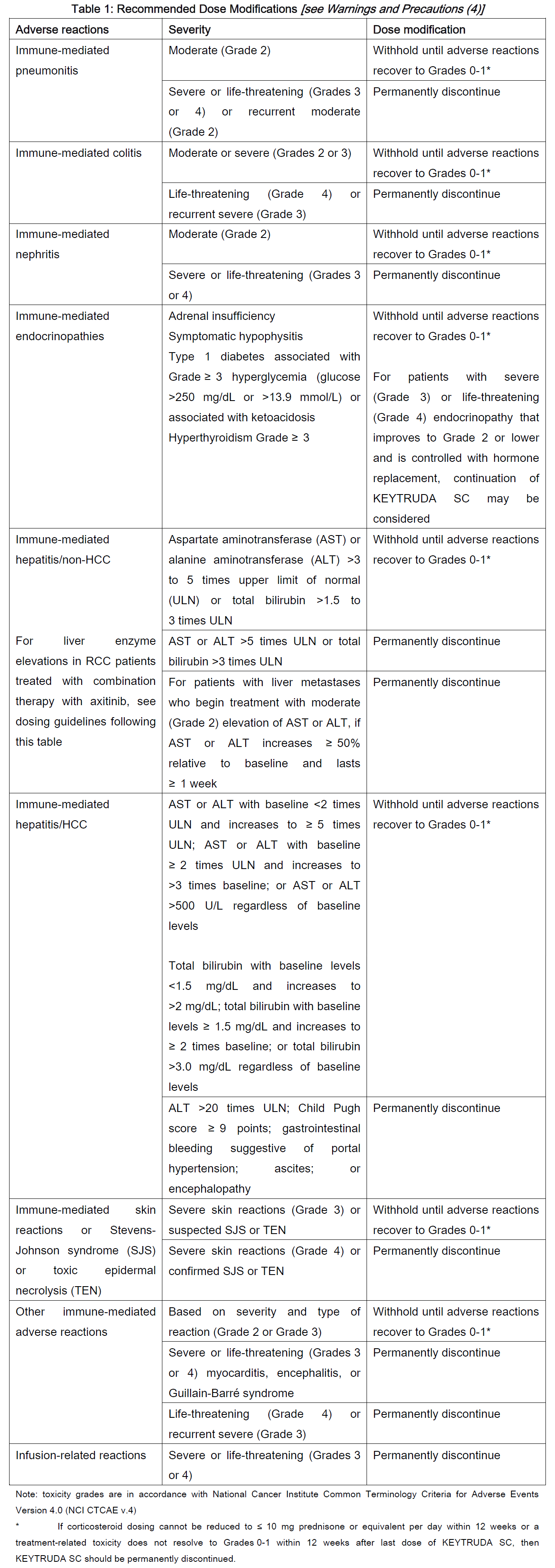
In patients with cHL with Grade 4 hematological toxicity, KEYTRUDA SC should be withheld until adverse reactions recover to Grades 0–1.
In patients with RCC being treated with KEYTRUDA SC in combination with axitinib:
If ALT or AST ≥ 3 times ULN but <10 times ULN without concurrent total bilirubin ≥ 2 times ULN, withhold both KEYTRUDA SC and axitinib until these adverse reactions recover to Grades 0–1. Consider corticosteroid therapy. Consider rechallenge with a single drug or sequential rechallenge with both drugs after recovery. If rechallenging with axitinib, consider dose reduction as per the axitinib prescribing information.
If ALT or AST ≥ 10 times ULN or >3 times ULN with concurrent total bilirubin ≥ 2 times ULN, permanently discontinue both KEYTRUDA SC and axitinib and consider corticosteroid therapy.
When administering KEYTRUDA SC in combination with lenvatinib, interrupt one or both or dose reduce or discontinue lenvatinib to manage adverse reactions as appropriate. For recommendations for management of adverse reactions of lenvatinib, refer to the prescribing information for lenvatinib. No dose reductions are recommended for KEYTRUDA SC.
Preparation and Administration
KEYTRUDA SC is ready to use. Do not dilute KEYTRUDA SC.
Do not shake.
Preparation of the Syringe
Equilibrate the vial of KEYTRUDA SC to room temperature (20°C to 25°C) for at least 30 minutes.
The unpunctured vial can be out of refrigeration (20°C to 25°C) for up to 24 hours prior to the preparation for administration.
Parenteral drug products should be inspected visually for particulate matter and discoloration prior to administration. KEYTRUDA SC is a clear to slightly opalescent, colorless to slightly yellow solution. Discard the vial if visible particles are observed.
KEYTRUDA SC is compatible with polypropylene and polycarbonate syringe material and stainless steel transfer and injection needles.
Withdraw either 2.4 mL (395 mg) or 4.8 mL (790 mg) using a sterile syringe and a transfer needle (18–21G recommended), according to the recommended dosage. To avoid needle clogging, change the needle to a 25–30G, 13 mm hypodermic injection needle immediately prior to subcutaneous injection.
Storage of Prepared Syringe
Once transferred from the vial into the syringe, chemical and physical in-use stability for the closed syringe has been demonstrated for up to 30 days at 2°C to 8°C (protected from light) and for up to 24 hours at room temperature (under ambient room light).
From a microbiological point of view, the product should be used immediately once transferred from the vial to the syringe. If not used immediately, in-use storage times and conditions prior to use are the responsibility of the user and would normally not be longer than 8 hours at room temperature (20°C to 25°C) or 24 hours at 2°C to 8°C, unless the preparation has taken place in controlled and validated aseptic conditions. The 24-hour period may include up to 8 hours at room temperature.Discard if storage time exceeds these limits.
If refrigerated, allow the filled syringe to come to room temperature for at least 30 minutes prior to use.
Do not freeze.
Administration
Inject KEYTRUDA SC into the subcutaneous tissue of the thigh or abdomen, avoiding the 5 centimeter area around the navel. Do not inject into skin that is damaged, sore, bruised, scarred, scaly, or has red patches.
Inject one 2.4 mL dose of KEYTRUDA SC (containing 395 mg) subcutaneously every 3 weeks over 1 minute, or
Inject one 4.8 mL dose of KEYTRUDA SC (containing 790 mg) subcutaneously every 6 weeks over 2 minutes.
Rotate injection sites for subsequent injections.
During treatment with KEYTRUDA SC, do not administer other medications for subcutaneous use at the same site as KEYTRUDA SC.
Discard any unused portion left in the vial.
2.2 Pediatric Patients
For melanoma and cHL, the recommended dose of KEYTRUDA SC in pediatric patients 12 years and older who weigh greater than 40 kg is either:
395 mg pembrolizumab every 3 weeks
790 mg pembrolizumab every 6 weeks
KEYTRUDA SC is administered as a subcutaneous injection into the thigh or abdomen over 1 minute (2.4 mL containing 395 mg) or 2 minutes (4.8 mL containing 790 mg).
For melanoma and cHL, the recommended dosage has not been established in pediatric patients 12 years of age and older who weigh 40 kg or less [see Use in Specific Population (6.3) – please refer to the Product Insert/Patient Information Leaflet published on HSA for the full drug information].
2.3 Geriatric Patients
No overall differences in safety or efficacy were reported between elderly patients (65 years and over) and younger patients (less than 65 years). No dose adjustment is necessary in this population.
2.4 Renal Impairment
No dose adjustment is needed for patients with mild or moderate renal impairment. KEYTRUDA SC has not been studied in patients with severe renal impairment.
2.5 Hepatic Impairment
No dose adjustment is needed for patients with mild or moderate hepatic impairment. KEYTRUDA SC has not been studied in patients with severe hepatic impairment.
Contraindications
3. CONTRAINDICATIONS
KEYTRUDA SC is contraindicated in patients with hypersensitivity to pembrolizumab or any of the inactive ingredients.